Maximizing ROI with Predictive Analytics in Business
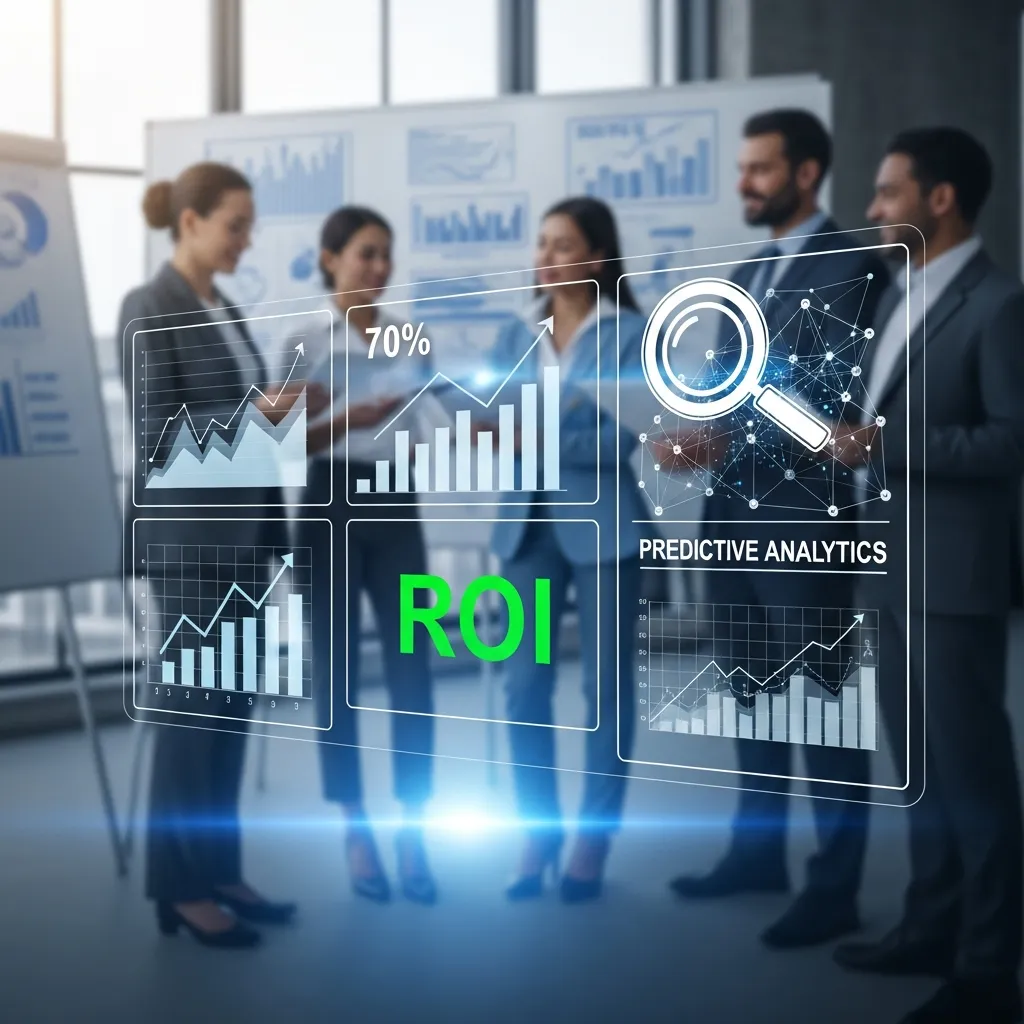
In today’s digital landscape, Predictive Analytics in Business helps companies forecast market trends, customer behavior, and risks before they occur. By using data, statistical models, and machine learning, businesses can make smarter decisions instead of relying only on past reports.
This approach improves ROI, optimizes resources, and uncovers new opportunities across industries like retail, finance, and healthcare. It also helps organizations shift from reactive decisions to proactive strategies, reducing costs and improving performance.
In this guide, we explore how Predictive Analytics in Business works, its key benefits, and how it transforms raw data into actionable insights for better business growth.
What Is Predictive Analytics and Why It Matters Today
Predictive analytics represents a specialized branch of advanced analytics that evaluates historical and current data to identify patterns and project possible future scenarios. At its essence, it seeks to assign probabilities to outcomes such as customer churn, product demand, or equipment failure allowing organizations to make decisions grounded in quantitative forecasts. In today s fast-paced environment, relying on intuition alone can expose businesses to unnecessary risk. By contrast, predictive analytics offers a structured, data-driven framework that reduces uncertainty and enhances the precision of strategic planning.
Central to this discipline is the integration of statistical modeling, machine learning algorithms, and domain expertise. Techniques range from linear regression and time-series analysis to ensemble methods like random forests or gradient boosting, and even deep learning architectures for complex, nonlinear relationships. The choice of technique depends on the nature of the problem, data availability, and the required level of interpretability. For regulated sectors like finance and healthcare, model transparency is imperative, while in marketing or supply chain contexts, achieving top-tier accuracy may take precedence.
In today s digital landscape, the volume and variety of data sources ranging from CRM systems and IoT sensors to social media feeds has grown exponentially. According to the National Institute of Standards and Technology (NIST), best practices in analytics involve robust data governance, rigorous validation, and continual monitoring to maintain model integrity. Organizations that invest in these capabilities can convert disparate data silos into cohesive insights, enabling a unified view of performance drivers and risk factors.
Moreover, predictive analytics is no longer reserved for large enterprises with massive IT budgets. Cloud-based platforms and open-source tools have democratized access, allowing small and mid-sized businesses to deploy forecast models with minimal infrastructure overhead. By partnering with academic institutions or leveraging government-sponsored datasets such as those available through the U.S. Census Bureau—even resource-constrained teams can accelerate data preparation and model development phases. Today, predictive analytics stands as a critical lever for companies seeking to thrive in an era defined by rapid change and evolving consumer preferences.
Core Components and Techniques of Predictive Analytics
Building an effective predictive analytics program requires a structured approach, starting with data collection and culminating in continuous model evaluation. The first step involves aggregating relevant datasets, which may include transactional records, customer demographics, sensor logs, digital interactions, and external market indicators. Data engineers and analysts collaborate to clean, normalize, and merge these sources, ensuring accuracy and consistency. Techniques such as imputation for missing values, outlier detection, and standardization are essential to prepare the foundation for reliable forecasting.
Feature engineering follows, where raw variables are transformed into meaningful predictors. For instance, combining purchase frequency with time since last transaction yields a recency-frequency metric that can improve customer lifetime value models. Seasonal patterns extracted from date-time stamps can enhance demand forecasting in retail or energy sectors. In manufacturing, operational logs may be processed into indicators like run-time hours or vibration metrics, feeding predictive maintenance algorithms. The efficacy of feature engineering often dictates the upper bound of model performance, making it a critical skill for data teams.
Once data is prepared, selecting the right algorithm is the next milestone. Simple linear or logistic regression models offer interpretability and speed, suitable for scenarios where transparency is paramount. Decision trees and ensemble methods—such as random forests and XGBoost—excel at capturing nonlinear interactions and handling high-dimensional data. Neural networks, including deep learning variants, can process unstructured inputs like images or text, unlocking advanced use cases such as quality inspection in manufacturing or sentiment analysis in customer feedback.
Model training and validation require sound experimental design. Splitting data into training, validation, and test subsets prevents overfitting and ensures generalizable performance. Cross-validation techniques and hyperparameter tuning refine model parameters, while performance metrics—such as mean absolute error (MAE), root mean squared error (RMSE), area under the curve (AUC), and precision-recall scores—help gauge predictive accuracy against business objectives. Following deployment, continuous monitoring is vital: drift detection alerts teams to shifts in data distributions, prompting retraining cycles to maintain forecasting fidelity in dynamic environments.
Concrete Benefits of Predictive Analytics for Businesses
Integrating predictive analytics into core business operations unlocks quantifiable benefits across multiple dimensions. Firstly, improved decision-making arises from data-driven insights, replacing gut instinct with objective forecasts. For planning and budgeting, finance teams can project revenue scenarios with tighter confidence intervals, enabling more accurate capital allocation. Marketing departments can leverage propensity scores to personalize offers, driving higher conversion rates while optimizing campaign spend.
Cost reduction is another significant advantage. Predictive maintenance models analyze equipment sensor data to detect early warning signs, scheduling service only when needed rather than following rigid intervals. This approach minimizes unplanned downtime, lowers repair expenses, and extends asset lifecycles. Supply chain managers can forecast demand fluctuations, adjusting inventory replenishment to avoid both stockouts and overstock situations—reducing carrying costs and boosting customer fulfillment rates simultaneously.
On the revenue side, predictive pricing engines can recommend dynamic price adjustments based on competitor activity, customer segments, and real-time demand signals. Retailers that adopt such models often report average order value increases of 5–10%, translating into meaningful top-line growth. In subscription-based businesses, churn prediction models flag at-risk customers, enabling targeted retention initiatives—such as tailored incentives or proactive outreach—that improve renewal rates.
Risk management also benefits from forward-looking analytics. Financial institutions deploy credit risk models to assess loan applicants, combining internal customer data with external credit bureau scores for robust underwriting decisions. Fraud detection systems analyze transaction patterns and user behavior indicators to identify anomalies, blocking suspicious activities before they escalate. In healthcare, predictive tools forecast patient readmissions and adverse events, guiding clinicians to allocate resources for high-risk cases and enhance treatment protocols.
Finally, organizations that lead with predictive analytics often secure a sustainable competitive advantage. By responding faster to market shifts, personalizing customer experiences, and optimizing operational workflows, they outpace peers who rely on retrospective reporting. This proactive stance in today’s fast-moving markets can significantly bolster a company’s brand reputation and long-term profitability.
Implementing Predictive Analytics: From Planning to Deployment

To ensure a successful predictive analytics initiative, start with clearly defined objectives tied to key performance indicators (KPIs). Whether your goal is to reduce maintenance costs by 15% or increase customer retention by 10%, quantifiable targets steer data requirements, feature selection, and model choice. Engaging cross-functional stakeholders—from IT, finance, and operations to marketing—early on fosters alignment and secures governance around data access and privacy considerations.
Next, establish a robust data infrastructure. This entails building or extending a data warehouse or data lake that consolidates internal records and relevant external datasets. Emphasize data quality through ongoing monitoring and governance frameworks. Tools for automated data validation can flag schema changes or missing values in real time, preventing silent model degradation after deployment.
Once your data environment is ready, assemble a multidisciplinary team of data scientists, analysts, and domain experts. Collaboratively develop and iterate predictive models using an agile methodology. Initial proofs of concept (POCs) should focus on narrow use cases with fast turnaround times to demonstrate early value. Leveraging open-source libraries in Python or R can accelerate development, while low-code/no-code platforms offer accessible alternatives for teams with limited coding resources.
As models mature, plan for integration into production systems. Common deployment mechanisms include exposing model endpoints via RESTful APIs, embedding forecasts in business intelligence dashboards, or integrating directly into enterprise resource planning (ERP) and customer relationship management (CRM) workflows. Ensure that each deployment includes a monitoring layer to track model inputs, outputs, and performance metrics continuously. Implement alerting systems to notify data teams of drift or anomalous predictions requiring retraining.
Finally, promote a data-driven culture across the organization. Provide stakeholders with interactive dashboards and self-service analytics tools, empowering them to explore forecasts and derive insights without constant IT intervention. Offer training sessions on interpreting predictive outputs and adjusting operational plans accordingly. By embedding predictive analytics into routine decision-making, companies reinforce its importance and drive sustained adoption throughout all levels of the enterprise.
Conclusion
Predictive analytics has emerged as a cornerstone capability in today’s data-driven world. By leveraging statistical algorithms and machine learning techniques, organizations can forecast future events, optimize operations, and make proactive decisions that enhance return on investment. From improved budgeting and targeted marketing to predictive maintenance and risk mitigation, the benefits span every facet of enterprise activity. However, realizing the full potential of predictive analytics requires a structured approach: defining clear objectives, ensuring high-quality data, assembling cross-functional teams, and embedding models into production systems with ongoing monitoring and retraining. As companies continue to navigate dynamic markets and evolving customer expectations, predictive analytics offers a path to sustainable growth and a solid competitive advantage. In this year, those who invest in robust analytics capabilities will be best positioned to anticipate opportunities, mitigate risks, and drive innovation across their organizations.
Frequently Asked Questions-Predictive Analytics in Business
What types of data are best suited for predictive analytics?
Predictive analytics thrives on both structured and unstructured data. Structured data—such as transactional records, customer demographics, and sensor readings—provides a reliable foundation, while unstructured data—like text from social media, images, or logs—can add depth when processed with natural language processing or computer vision techniques.
How do I choose the right algorithm for my predictive model?
The choice depends on the problem nature, data volume, and the importance of interpretability. Start with simpler models like linear regression for quick insights, then progress to ensemble methods (e.g., random forests, XGBoost) or neural networks for complex patterns. Always evaluate models against validation metrics relevant to your business objectives.
What are common pitfalls when deploying predictive models?
Key pitfalls include data drift (where new data no longer matches training distributions), insufficient monitoring, and overfitting. Mitigate these by implementing continuous monitoring, setting up automated alerts for performance degradation, and retraining models regularly with fresh data.
Can small businesses benefit from predictive analytics?
Absolutely. Cloud-based analytics platforms and open-source tools have lowered barriers to entry. Small businesses can start with niche use cases—like churn prediction or demand forecasting—and scale as they demonstrate ROI. Partnering with consultants or leveraging government data can further accelerate adoption.
How do I measure the ROI of a predictive analytics project?
Define clear KPIs at the outset, such as cost savings from reduced downtime, lift in conversion rates, or percentage improvement in forecasting accuracy. Compare baseline metrics against post-deployment results to quantify business impact and calculate ROI over time.