Emotional Marketing for SaaS Brands: Complete Strategy to Build Trust and Loyalty

Emotional marketing for SaaS brands is the practice of using emotions such as trust, confidence, belonging, relief, ambition, and security to create stronger connections with software customers. Although SaaS products are often promoted through features, pricing, and technical benefits, emotional messaging can make a brand more memorable and relatable. A successful strategy combines customer psychology, storytelling, personalization, social proof, and authentic communication across the entire SaaS customer journey.
SaaS marketing is often treated as a numbers game. Companies compete on pricing, features, integrations, automation, dashboards, and performance claims. While these factors matter, they do not fully explain why customers choose one software brand over another.
People make software decisions too.
A founder wants to feel confident that the product will help the business grow. A marketing manager wants reassurance that a new platform will not create unnecessary complexity. An employee wants to know that the software will make their daily work easier rather than harder.
This is where emotional marketing for SaaS brands becomes valuable.
Emotional marketing connects a product’s functional benefits with the feelings customers experience before, during, and after a purchase. Instead of simply saying, “Our platform saves time,” a SaaS company can communicate the relief of escaping repetitive work and the confidence that comes from having more control.
Research published by Harvard Business Review has found that emotional connection can be a significant driver of customer value, showing why businesses should look beyond basic satisfaction when building customer relationships.
For SaaS companies operating in highly competitive markets, emotional connection can become a meaningful source of differentiation.
What Is Emotional Marketing for SaaS Brands?
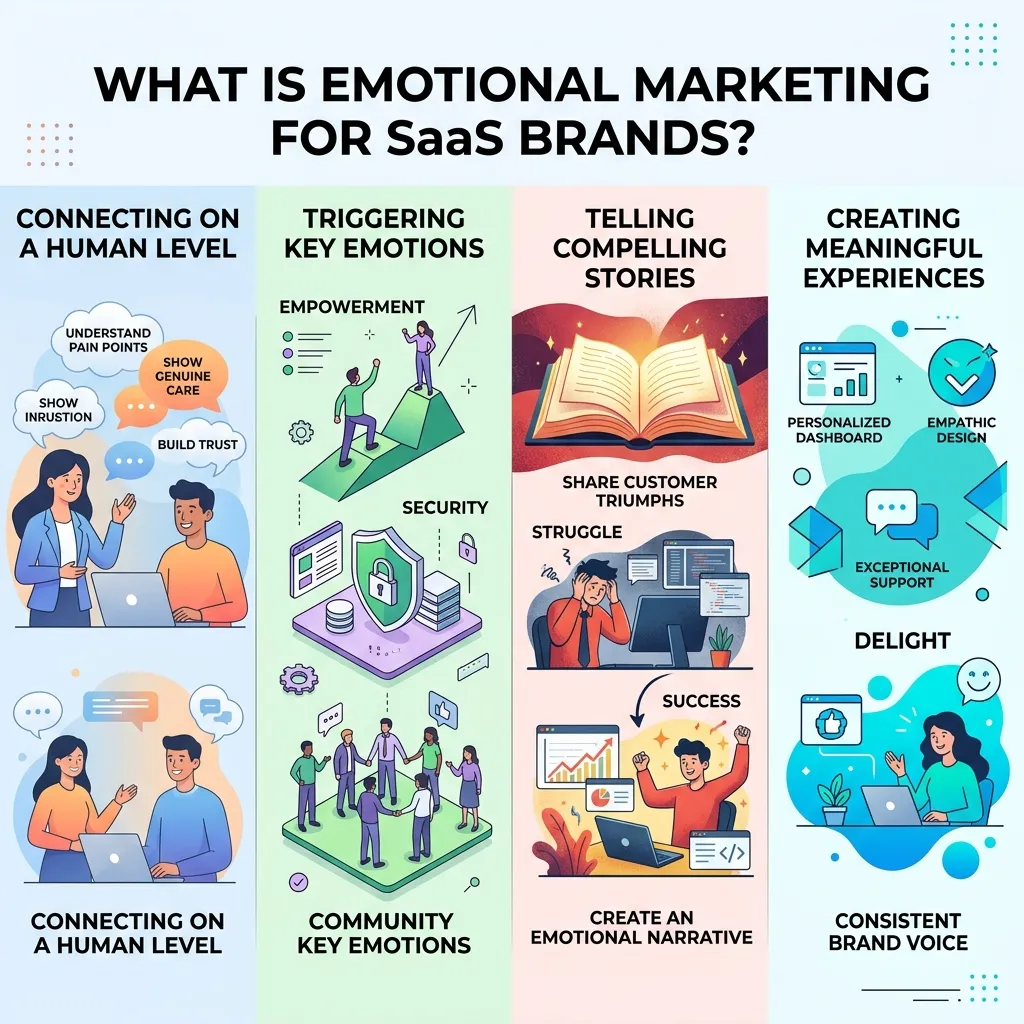
Emotional marketing for SaaS brands means creating marketing messages and customer experiences that intentionally appeal to the emotions behind software-buying decisions.
Traditional SaaS marketing might focus on:
- Features
- Pricing
- Integrations
- Technical specifications
- Automation
- Performance
- Security
- Productivity
Emotional SaaS marketing connects those features to human outcomes.
For example:
Feature: Automated reporting
Functional benefit: Saves employees time
Emotional benefit: Reduces stress and gives teams confidence in their decisions
Another example:
Feature: Cloud-based collaboration
Functional benefit: Employees can work together remotely
Emotional benefit: Creates a stronger feeling of connection and control
The goal is not to manipulate customers. Instead, it is to understand what customers genuinely care about and communicate those benefits in a more human way.
Why Emotional Marketing Matters for SaaS Companies
SaaS purchases frequently involve uncertainty.
Customers may wonder:
- Will this software actually solve my problem?
- Will implementation be difficult?
- Can my team learn it quickly?
- Is the subscription worth the cost?
- Will my data be safe?
- Can I trust this company?
- What happens if the product stops meeting my needs?
These questions create emotional responses.
1. SaaS Products Can Feel Complicated
Software can be difficult to understand before customers use it. Emotional messaging can simplify the value proposition by focusing on outcomes instead of technical language.
Instead of:
“AI-powered workflow orchestration with advanced automation.”
A customer-centered message might communicate:
“Spend less time managing repetitive tasks and more time growing your business.”
The second message connects technology to a meaningful human outcome.
2. Trust Is Essential
Trust is particularly important when customers are giving a SaaS company access to business data, financial information, customer information, or internal workflows.
Your marketing should therefore communicate:
- Reliability
- Transparency
- Security
- Expertise
- Consistency
- Customer support
Trust should not be created through advertising alone. The entire customer experience should reinforce it.
3. Emotional Connections Can Support Loyalty
A customer who only sees a SaaS platform as a replaceable tool may switch when a cheaper competitor appears.
A customer who associates the brand with confidence, productivity, success, or belonging may have a stronger relationship with the company.
This is why emotional marketing should continue after acquisition rather than stopping when someone clicks “Start Free Trial.”
The Most Powerful Emotions for SaaS Marketing
Different SaaS audiences respond to different emotional motivations. The right emotion depends on the problem, customer segment, and buying stage.
Trust and Security
Trust is one of the most important emotions for software brands.
Use messaging that demonstrates:
- Transparent pricing
- Clear policies
- Security practices
- Customer support
- Reliable performance
- Real customer experiences
Avoid exaggerated claims that can damage credibility.
Relief
Many SaaS products exist because customers are frustrated with manual processes.
If your software eliminates repetitive work, communicate the relief that follows.
For example:
- Stop chasing spreadsheets.
- Reduce repetitive tasks.
- Simplify complicated workflows.
- Get your team out of administrative work.
The emotional outcome is often more persuasive than the feature itself.
Confidence
Customers want to feel confident that they are making the right decision.
Build confidence with:
- Product demonstrations
- Case studies
- Customer testimonials
- Transparent comparisons
- Free trials
- Helpful educational content
Belonging
SaaS brands can also create communities around shared goals.
Customers may want to feel that they are part of:
- A professional community
- A group of innovative companies
- A growing creator economy
- A community of entrepreneurs
- A network of successful teams
Community-based positioning can turn a software product into something customers identify with.
Ambition
Many SaaS customers are not simply buying software. They are buying progress.
They want to:
- Grow revenue
- Save time
- Build a better business
- Improve productivity
- Scale operations
- Become more competitive
Connect your product to these aspirations without making unrealistic promises.
How to Build an Emotional Marketing Strategy for SaaS Brands
1. Understand Your Customer’s Emotional Drivers
Start with customer research.
Do not only ask:
“What features do customers want?”
Also ask:
- What frustrates them?
- What makes them nervous?
- What does success look like?
- What are they trying to avoid?
- What would make their work easier?
- What outcome would make them feel successful?
Customer interviews, surveys, reviews, support conversations, and sales calls can reveal these emotional drivers.
For a broader understanding of emotional decision-making, your readers can also explore this internal resource on the emotional buying journey.
2. Create an Emotional Customer Profile
Build a profile that goes beyond demographics.
For each major customer segment, identify:
| Customer Factor | Example |
|---|---|
| Primary problem | Too much manual work |
| Desired outcome | Higher productivity |
| Main emotion | Relief |
| Buying concern | Implementation difficulty |
| Desired emotion | Confidence |
| Key message | Simplify work without adding complexity |
This gives your marketing team a practical emotional framework.
3. Connect Features With Feelings
Every important product feature should have a human benefit behind it.
Consider this framework:
Feature → Functional Benefit → Emotional Outcome
For example:
Analytics dashboard → Faster insights → Greater confidence
Automation → Less manual work → Relief
Collaboration tools → Better teamwork → Connection
Security controls → Better protection → Peace of mind
This framework makes technical SaaS marketing easier to understand.
4. Use Customer-Centered Storytelling
Storytelling can transform a technical product into a relatable experience.
Instead of making the company the hero, make the customer the hero.
A simple SaaS story structure can be:
Problem → Frustration → Discovery → Transformation → Outcome
For example:
A small team spends hours manually creating reports. Employees become frustrated and managers struggle to make quick decisions. They adopt an automation platform, reduce repetitive work, and finally have more time to focus on strategic projects.
The software is important, but the customer’s transformation is the real story.
For additional storytelling inspiration, explore this guide to the role of storytelling in emotional marketing.
Emotional Marketing Across the SaaS Customer Journey
Emotions change as customers move through the buying journey.
Awareness Stage
At this stage, customers may feel:
- Frustrated
- Curious
- Overwhelmed
- Uncertain
Your content should identify their problems and demonstrate understanding.
Useful content includes:
- Educational blog posts
- Videos
- Social media content
- Industry insights
- Problem-focused guides
Consideration Stage
Customers are now comparing solutions.
They may feel:
- Doubt
- Excitement
- Risk
- Curiosity
Use:
- Case studies
- Product comparisons
- Demonstrations
- Testimonials
- Expert content
- Transparent pricing information
Decision Stage
The dominant emotion may be uncertainty.
Reduce perceived risk through:
- Free trials
- Clear onboarding information
- Product demos
- Customer support
- Security information
- Reviews
- Guarantees where appropriate
Retention Stage
After purchase, customers want reassurance that they made the right decision.
Use onboarding emails, educational resources, product tips, customer communities, and proactive support to reinforce confidence.
Use Social Proof to Strengthen Emotional Trust
Social proof can make an unfamiliar SaaS brand feel safer.
Useful forms include:
- Customer testimonials
- Case studies
- Reviews
- User-generated content
- Customer logos
- Expert endorsements
- Community discussions
However, social proof should be specific.
Instead of:
“Our customers love us.”
Use a testimonial that explains what changed for the customer.
For example:
“Our team reduced weekly reporting work and finally had more time for strategic planning.”
Specific outcomes create credibility and emotional relevance.
You can also strengthen this strategy by studying the psychology behind social proof in marketing.
Personalization and Emotional Marketing
Personalization can make customers feel understood.
SaaS brands can personalize:
- Email campaigns
- Product recommendations
- Onboarding messages
- Website content
- In-app notifications
- Educational resources
- Customer success communication
For example, a new customer who has not completed onboarding should not necessarily receive the same email as an experienced customer.
Relevant personalization communicates:
“We understand where you are and what you need next.”
That can strengthen the emotional relationship between the customer and the brand.
Emotional Marketing in SaaS Content
Your content strategy should reflect customer emotions at every stage.
Blog Content
Write about real customer problems instead of only discussing product features.
Examples:
- How to Reduce Workflow Stress
- How Automation Helps Small Teams
- How to Choose Software With Confidence
- Ways to Simplify Remote Collaboration
Email Marketing
Email can reinforce emotional connections through:
- Helpful onboarding
- Customer success stories
- Personalized recommendations
- Milestone celebrations
- Educational content
- Appreciation messages
Social Media
SaaS social content does not have to be completely technical.
Show:
- Customer stories
- Team culture
- Behind-the-scenes moments
- Product transformations
- Industry challenges
- Community achievements
Avoid Manipulative Emotional Marketing
Emotional marketing should be authentic.
There is a major difference between connecting with emotions and manipulating emotions.
Avoid:
- Fake urgency
- False scarcity
- Exaggerated fear
- Misleading testimonials
- Unrealistic success promises
- Hidden pricing
- Fear-based claims without evidence
A SaaS company should use emotion to clarify genuine value, not pressure people into purchases.
This is especially important because trust is difficult to build and easy to lose.
Measure Emotional Marketing Performance
Emotional marketing should still be measurable.
Track both behavioral and relationship-focused metrics.
Important Metrics
Conversion Rate:
Shows whether emotional messaging contributes to action.
Trial-to-Paid Conversion:
Measures how effectively your experience turns trial users into customers.
Customer Retention:
Helps determine whether customers continue seeing value.
Churn Rate:
A high churn rate may indicate that emotional promises are not being matched by the product experience.
Customer Lifetime Value:
Helps evaluate the long-term commercial value of stronger customer relationships.
NPS and Customer Feedback:
Can reveal how customers feel about the brand and experience.
Engagement Rate:
Useful for evaluating emotional content on social platforms and other channels.
The goal is not to prove that emotion caused every conversion. Instead, compare different messages and experiences to understand which emotional positioning produces stronger customer behavior.
7 Practical Emotional Marketing Ideas for SaaS Brands
Here are seven tactics SaaS companies can implement:
- Tell customer transformation stories instead of only listing features.
- Use benefit-focused language that connects functionality to human outcomes.
- Show real customers whenever possible.
- Create onboarding experiences that reduce uncertainty.
- Celebrate customer milestones such as reaching a usage goal.
- Build a community around your product’s broader mission.
- Use customer feedback to continually improve emotional messaging.
The strongest strategy combines several of these rather than relying on one campaign.
Common Emotional Marketing Mistakes SaaS Brands Should Avoid
Focusing Only on Features
A long feature list does not automatically communicate value.
Explain why each feature matters to the customer.
Using Generic Emotional Language
Words like “innovative,” “powerful,” and “revolutionary” have limited impact when every competitor uses them.
Use specific customer outcomes instead.
Making the Brand the Hero
Customers generally care more about their own problems than the company’s achievements.
Position your customer as the hero of the story.
Ignoring Post-Purchase Emotions
The emotional experience after purchase can determine whether customers stay.
Support, onboarding, communication, and product experience must match the promises made during marketing.
A Simple Framework for Emotional Marketing for SaaS Brands
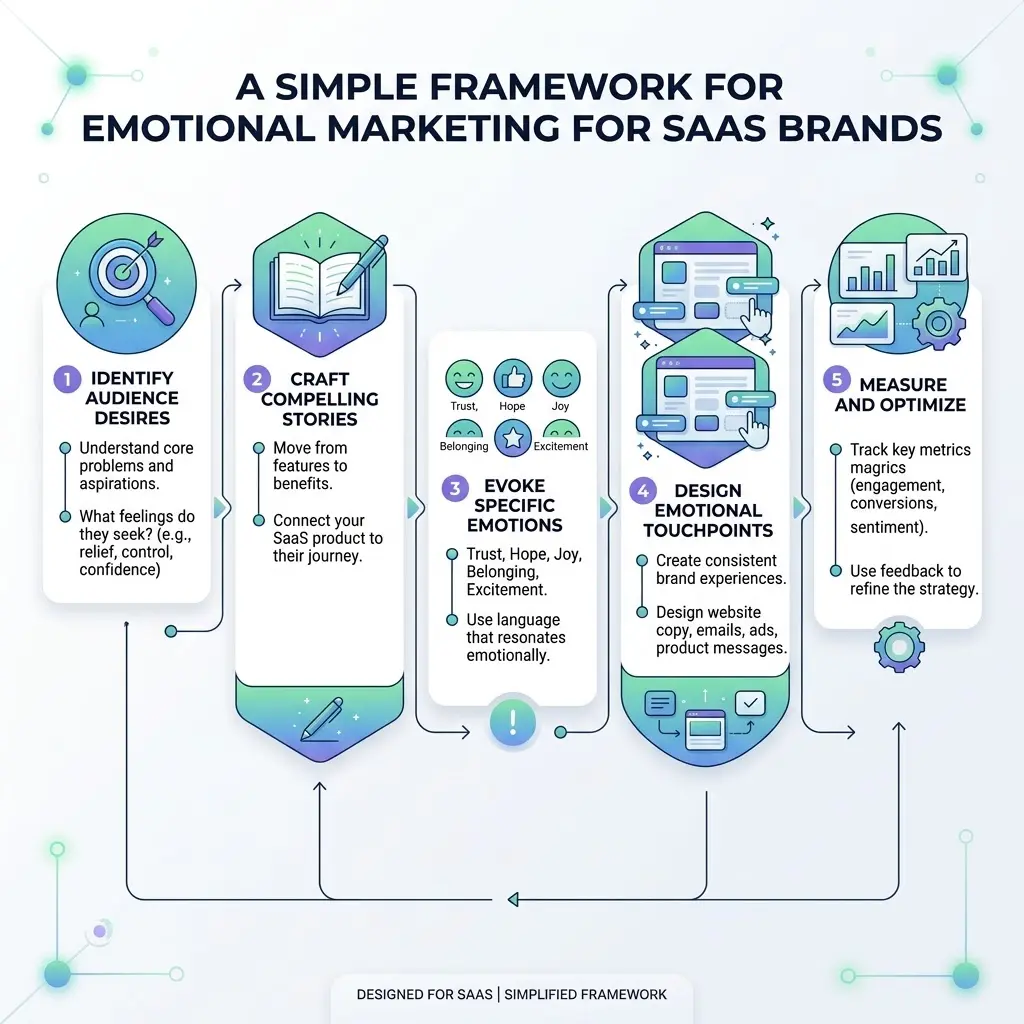
A practical framework is:
Understand → Map → Connect → Communicate → Measure → Improve
Understand
Research customer problems and motivations.
Map
Identify emotions across the customer journey.
Connect
Link product features to emotional outcomes.
Communicate
Use those insights across ads, websites, emails, content, and sales materials.
Measure
Track conversions, retention, engagement, feedback, and customer value.
Improve
Test different messages and continuously refine your approach.
This creates an ongoing emotional marketing system rather than a one-time advertising campaign.
Conclusion
Emotional marketing for SaaS brands is not about replacing product features, pricing, or performance with emotional language. It is about making those functional benefits more meaningful to the people who use them.
Customers want software that works, but they also want to feel confident about their decisions, relieved from unnecessary work, supported by the company, and optimistic about their future.
SaaS brands that understand these emotional drivers can create stronger messaging, more memorable customer experiences, and deeper relationships.
The best approach is simple: understand what customers feel, connect those emotions to genuine product value, and deliver on the promise throughout the entire customer journey.
Frequently Asked Questions
1. What is emotional marketing for SaaS brands?
Emotional marketing for SaaS brands uses customer emotions such as trust, relief, confidence, security, belonging, and ambition to communicate the value of software in a more human and relatable way.
2. Why is emotional marketing important for SaaS?
SaaS products can be complex and expensive, which creates uncertainty for buyers. Emotional marketing can help reduce perceived risk and create stronger connections between customers and software brands.
3. What emotions work best for SaaS marketing?
Trust, confidence, relief, security, belonging, curiosity, and ambition are commonly useful emotions. The best choice depends on the customer’s problem and buying stage.
4. Can B2B SaaS brands use emotional marketing?
Yes. B2B buying decisions are still made by people. Business buyers consider practical factors, but risk, confidence, reputation, career concerns, and trust can also influence decisions. Research from Google and CEB has specifically examined emotional connection in B2B purchasing.
5. How can SaaS companies use storytelling?
SaaS companies can tell stories showing how customers moved from a frustrating problem to a better outcome. The customer should be the central character, while the software acts as the solution.
6. Is emotional marketing manipulative?
It can become manipulative if brands use false claims, artificial fear, fake urgency, or misleading testimonials. Ethical emotional marketing communicates genuine customer benefits honestly.
7. How does emotional marketing improve SaaS customer loyalty?
When customers associate a SaaS brand with positive experiences such as trust, confidence, and success, the relationship can become stronger than a purely feature-based connection.
8. Should SaaS landing pages use emotional messaging?
Yes. Landing pages can combine emotional benefits with clear product information. For example, explain how automation can reduce workload while also showing the specific automation features available.
9. How can SaaS brands measure emotional marketing?
They can compare conversion rates, trial-to-paid conversions, retention, churn, customer feedback, engagement, customer lifetime value, and other relevant metrics before and after messaging changes.
10. What is the difference between emotional and logical SaaS marketing?
Logical marketing emphasizes facts, features, pricing, specifications, and measurable benefits. Emotional marketing focuses on feelings and human outcomes. Effective SaaS marketing usually combines both.
11. Can small SaaS companies use emotional marketing?
Absolutely. Small SaaS companies can often use their size as an advantage by creating authentic founder stories, personalized communication, customer communities, and highly relatable content.
12. What is the most important rule for emotional SaaS marketing?
The most important rule is authenticity. Choose emotions that genuinely reflect customer needs and make sure the actual product experience delivers the promised value.