Mastering the Anchoring Effect in Pricing to Boost Your Sales
The anchoring effect in pricing is a cognitive bias where consumers rely heavily on the first piece of information they receive (the “anchor”) when making purchasing decisions. By strategically setting initial price points, businesses can influence consumer perception, making subsequent prices seem more attractive and driving higher overall sales.
Have you ever walked into a store, seen a designer jacket priced at $1,000, and then felt relieved to find a similar one for $400? The $400 jacket might still be expensive, but compared to the initial $1,000 tag, it feels like a bargain. This psychological phenomenon is known as the anchoring effect in pricing.
The anchoring effect in pricing occurs because human brains are wired to use initial information as a reference point for all subsequent judgments. When applied to pricing strategies, this bias can shape how consumers perceive the value of a product or service. If an initial price is set high, any lower price that follows will seem reasonable.
Understanding the anchoring effect in pricing is critical for both businesses and consumers. For companies, it offers a powerful tool to optimize revenue and present products more attractively. For consumers, recognizing this bias is the first step toward making more rational, budget-conscious decisions.
The Psychology Behind Anchoring

Cognitive biases act as mental shortcuts that help us process information quickly. However, these shortcuts sometimes lead to systematic errors in judgment. The anchoring effect in pricing is one of the most prominent examples of this.
Psychologists Daniel Kahneman and Amos Tversky first documented this phenomenon in the 1970s. They discovered that people naturally cling to initial figures when estimating unknown quantities. When the brain processes initial information, it struggles to adjust away from that starting point adequately. Even if the anchor is completely arbitrary, it heavily influences the final decision.
Historical Context and Famous Experiments
Kahneman and Tversky demonstrated this bias through a classic experiment involving a rigged wheel of fortune. Participants spun the wheel, which always landed on either 10 or 65. They were then asked to estimate the percentage of African nations in the United Nations. Those who landed on 10 gave significantly lower estimates than those who landed on 65. The random number served as an anchor, skewing their logic.
In another famous study, real estate agents were asked to evaluate a house. They were given a tour of the property and a booklet containing the home’s listing price. Agents who saw a higher listing price consistently appraised the house at a higher value than those who saw a lower listing price. This historical context directly translates to modern retail and digital commerce, proving that the anchoring effect in pricing shapes professional and amateur judgments alike.
Applications of the Anchoring Effect in Pricing
Businesses leverage this cognitive bias through various distinct strategies.
Setting the Anchor
Setting a high initial price point establishes a premium perception of the brand. When a company launches a flagship product at a steep price, it anchors the customer’s expectations, making standard models seem highly affordable by comparison.
Decoy Pricing
Decoy pricing involves introducing a less attractive option to make another choice seem better. If a small coffee is $3, a medium is $6, and a large is $6.50, the medium serves as a decoy. The anchor of the $6 medium makes the large feel like an unbeatable deal for just fifty cents more.
Bundling
Bundling anchors value by combining multiple products or services. A software package priced at $100 might seem steep. But if a company shows that the individual tools cost $150 when bought separately, the $150 serves as the anchor, highlighting the $100 bundle as a massive saving.
Tiered Pricing
Presenting premium options first is a classic application of the anchoring effect in pricing. By showing the most expensive “Enterprise” tier before the “Pro” or “Basic” tiers, SaaS companies anchor the user to a high number, making the middle-tier option look highly reasonable.
Reference Pricing
This strategy uses external or internal reference points. A store might display the “Manufacturer’s Suggested Retail Price” (MSRP) alongside its own lower selling price. The MSRP acts as the anchor to highlight the discount.
Price Negotiations
In salary negotiations or B2B sales, the power of the first offer cannot be overstated. The party that makes the first offer sets the anchor, and all subsequent counteroffers typically revolve closely around that initial number.
How Businesses Use the Anchoring Effect

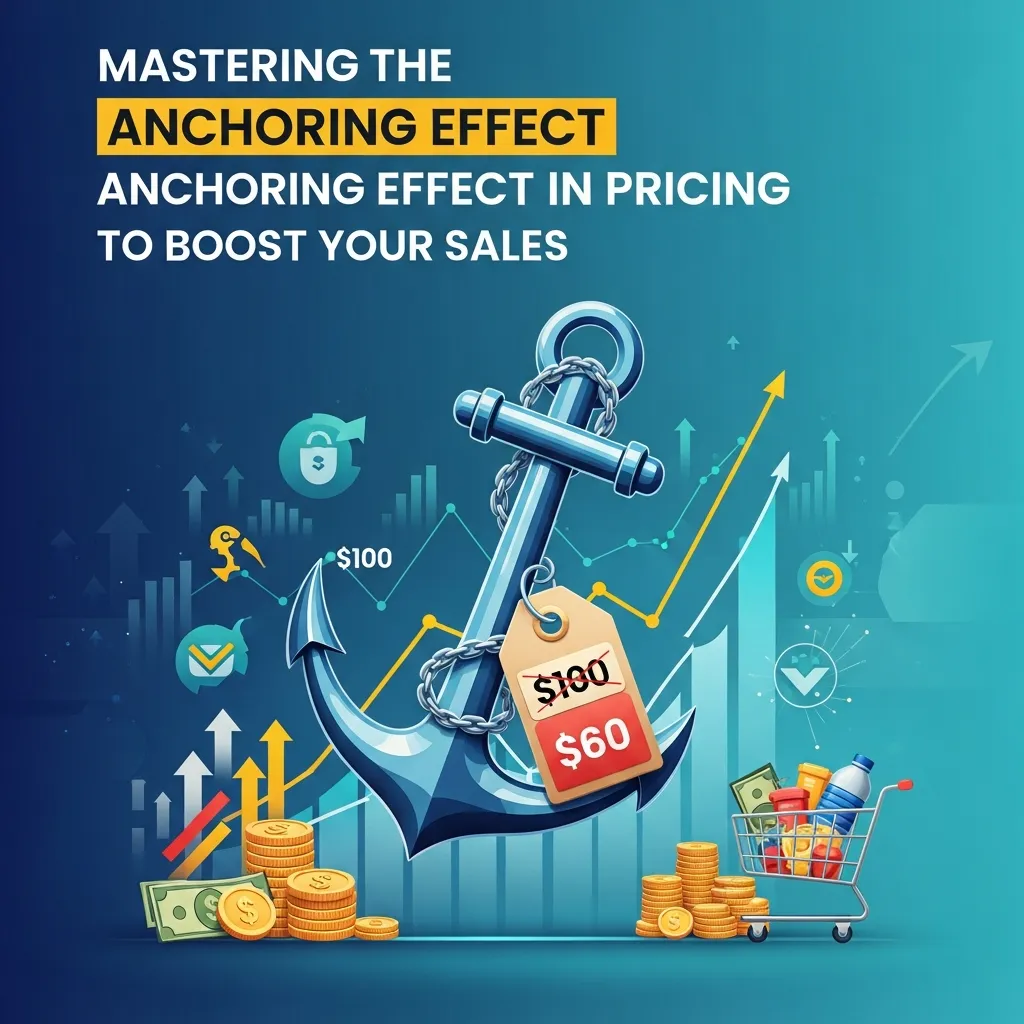
Retailers use the anchoring effect in pricing constantly through sale prices and original prices. Seeing a crossed-out $100 tag next to a $50 tag makes the purchase highly tempting.
Software and subscription models use tiered pricing to guide users toward a specific package. Service industries, like consulting or legal fees, often quote a comprehensive package first before offering a scaled-down version. In real estate and automotive sales, sellers list properties or cars slightly above their target price to set a high anchor, allowing room for the buyer to negotiate down and feel victorious.
Customer Journeys with Predictive Analytics and Anchoring
Modern businesses do not have to guess what anchor will work best. Mapping out Customer Journeys with Predictive Analytics helps companies identify the optimal anchor points for different audience segments.
By analyzing past browsing behaviors and purchase histories, predictive analytics can forecast what price point a specific user is most likely to accept as an anchor. Businesses can then tailor their anchoring strategies based on customer behavior. For example, a returning customer with a history of buying premium items might be shown a higher anchor than a first-time visitor. Integrating this bias into personalized marketing ensures maximum effectiveness and higher conversion rates.
Neuromarketing Basics and Anchoring
Understanding Neuromarketing Basics offers deeper insights into brain responses to pricing cues. Neuromarketing studies show that prices trigger specific neural responses related to pain and reward.
How a price is visually presented significantly influences the anchoring effect in pricing. For instance, removing the dollar sign (e.g., “50” instead of “$50”) reduces the pain of paying. Placing the original high price in a bold, large font and the discounted price in a different color acts as subliminal messaging. It visually reinforces the anchor and the perceived reward of the discount.
Ethical Considerations and Consumer Awareness
While the anchoring effect in pricing is a powerful marketing tool, it raises ethical questions. Anchoring becomes manipulative when the initial price is artificially inflated simply to present a fake discount. This practice, often known as deceptive pricing, is illegal in many jurisdictions.
Empowering consumers to recognize and counter anchoring involves education. Shoppers should research market averages instead of relying on the seller’s initial price. For businesses, building trust through transparent pricing is essential. Using genuine anchors—like the actual cost of previous models—creates a fair value exchange and fosters long-term customer loyalty.
Case Studies of Successful Anchoring in Pricing
Many major brands have successfully implemented the anchoring effect in pricing.
When Apple introduced the iPad, Steve Jobs famously stood on stage and mentioned that pundits expected the device to cost $999. A large “$999” appeared on the screen behind him. After explaining the product’s features, he revealed the actual price was $499. The $999 served as an anchor, making $499 look incredibly cheap for a revolutionary device.
Another famous example is Williams-Sonoma. They introduced a bread maker for $275, which saw poor sales. Instead of lowering the price, they introduced a slightly larger, better model for $429. The $429 model served as a decoy and an anchor. Sales of the $275 model skyrocketed because it suddenly appeared to be a fantastic deal.
Measuring the Impact of Anchoring

Businesses test the effectiveness of their anchoring strategies primarily through A/B testing. Companies might show one group of visitors a tiered pricing page starting with the highest price, and another group a page starting with the lowest price.
Key metrics to track include conversion rates, average order value (AOV), and customer acquisition cost. Adjusting anchors based on this data ensures the strategy remains effective as market conditions change.
Overcoming the Anchoring Effect
Consumers can make rational decisions by seeking external reference points. Before accepting a discount, check competitor prices. Ignore the “original” price and ask yourself if the item is worth the final price based on its utility to you.
For businesses, creating fair and effective anchoring means focusing on real value. Do not inflate prices artificially. Use bundling and tiered pricing to offer genuine choices that cater to different customer needs without crossing ethical boundaries.
The Future of Behavioral Pricing Strategies
The anchoring effect in pricing remains one of the most reliable and impactful psychological triggers in commerce. Whether you are running a SaaS startup or a global retail chain, understanding how initial figures shape consumer perception allows you to construct smarter, more effective pricing architectures.
As we look toward the future, the intersection of pricing psychology and artificial intelligence will only deepen. With dynamic pricing models and personalized analytics, the ability to present the perfect anchor to the right customer at the right time will become a standard business practice.
FAQs
1. What is the anchoring effect in pricing?
The anchoring effect in pricing is a psychological bias where consumers rely heavily on the first price they see. This initial price acts as a reference point, influencing how they judge the fairness of all subsequent prices.
2. How does the anchoring effect influence purchasing decisions?
It makes lower subsequent prices look like better deals. If a shopper sees a $200 shirt first, a $100 shirt looks highly affordable, increasing the likelihood of a purchase.
3. Can the anchoring effect be used unethically?
Yes. It becomes unethical and sometimes illegal when a business artificially inflates a “regular” price purely to offer a fake discount, misleading the consumer about the product’s true value.
4. What are some common examples of anchoring in retail?
Common retail examples include “compare at” pricing, crossed-out original prices next to sale prices, and displaying the most expensive items at the front of the store.
5. How does decoy pricing relate to the anchoring effect?
Decoy pricing introduces a strategically priced third option to make one of the other options look more attractive. The decoy acts as an anchor that frames the target product as the best value.
6. Can consumers avoid being influenced by the anchoring effect?
Consumers can mitigate the effect by actively researching average market prices, setting firm budgets beforehand, and evaluating the product’s actual utility rather than the perceived discount.
7. What role do Customer Journeys with Predictive Analytics play in pricing strategies?
They help businesses analyze past customer behavior to determine the most effective price anchors for specific user segments, allowing for highly personalized and optimized pricing displays.
8. How can Neuromarketing Basics inform anchoring strategies?
Neuromarketing reveals how the brain processes pricing visually and emotionally. This helps businesses format price tags, fonts, and colors to maximize the subconscious impact of the anchor.
9. Is a higher anchor always better?
Not necessarily. If an anchor is unrealistically high, it can damage brand credibility, alienate budget-conscious customers, and cause shoppers to abandon the purchase altogether.
10. How does the anchoring effect differ from framing?
Anchoring relies on a specific initial numerical value to influence judgment. Framing relates to how the information is presented conceptually, such as highlighting a “20% success rate” versus an “80% failure rate.”
11. What is a reference price in the context of anchoring?
A reference price is the standard price against which a buyer compares the current selling price. This can be an internal reference (memory of past prices) or an external reference (MSRP).
12. How do businesses test the effectiveness of their anchoring strategies?
Businesses use A/B testing to present different pricing layouts to different website visitors, measuring which anchors lead to higher conversion rates and higher average order values.