Emotional Marketing for Food & Beverage Brands
Emotional marketing for food & beverage brands works because eating and drinking were never purely functional acts to begin with. A cup of coffee is rarely just caffeine, and a bag of chips is rarely just a snack — both carry memory, comfort, identity, and mood. Brands that understand this sell a feeling first and a product second, and it shows up directly in loyalty, repeat purchases, and word of mouth.
This matters more than ever in a category where shelves are crowded, ingredient lists look increasingly similar, and price alone rarely wins long-term loyalty. Shoppers today are choosing brands based on how a product makes them feel just as much as how it tastes, which is exactly why emotional marketing has become central to food and beverage strategy rather than a nice-to-have layer on top of it.
In this guide, we’ll break down the specific emotional triggers that drive food and beverage purchases, how brands use color, packaging, and storytelling to activate them, and how to build an emotional marketing strategy that feels authentic rather than manipulative.
Why Emotional Marketing Works So Well for Food & Beverage
Food and drink sit closer to memory and identity than almost any other product category. Smell and taste are two of the senses most strongly linked to emotional memory, which means a single bite or sip can instantly transport someone back to a childhood kitchen, a specific holiday, or a comforting routine. Marketers who tap into this connection aren’t inventing an emotional response — they’re simply giving shoppers permission to feel it on purpose.
This is also a category where trust and safety carry unusually high emotional weight. People are literally putting your product into their bodies, which makes honesty, clean sourcing, and consistency feel personal in a way that, say, a software subscription rarely does. Understanding consumer behavior in digital marketing more broadly helps explain why: purchase decisions are rarely as rational as shoppers themselves believe, and food is one of the categories where emotion visibly overrides logic most often. When a food or beverage brand gets emotional marketing right, it isn’t just selling flavor — it’s selling reassurance, belonging, and a small moment of joy in someone’s day.
5 Emotional Triggers That Drive Food & Beverage Purchases
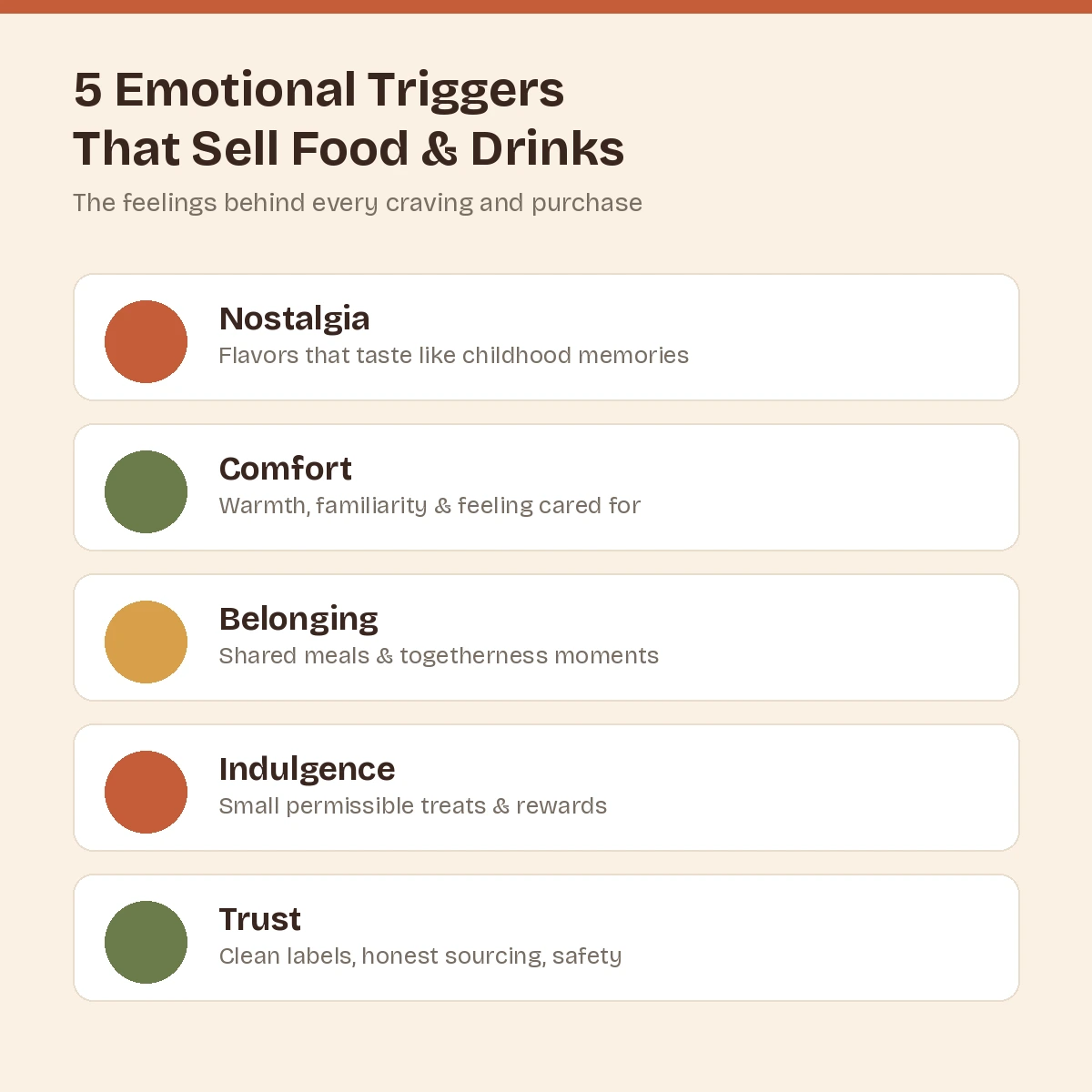
Nostalgia — Flavors, packaging, and slogans that echo childhood or a simpler time consistently outperform purely novelty-driven positioning, especially in snacks and comfort foods.
Comfort — Warmth, familiarity, and the feeling of being cared for drive repeat purchases of everyday staples far more than aggressive discounting does.
Belonging — Shared meals, family recipes, and togetherness moments tap into one of the strongest human needs, making food brands natural vehicles for community-driven marketing.
Indulgence — Positioning a treat as a small, permissible reward — rather than something to feel guilty about — consistently increases both purchase frequency and brand affection.
Trust — Clean labels, transparent sourcing, and consistent quality reduce the anxiety that often surrounds what people put into their bodies, turning trust itself into an emotional benefit.
Understanding what emotion sells the most in your specific category is worth researching directly, since the balance between these five triggers shifts depending on whether you’re selling an indulgent snack, a functional beverage, or a family staple.
Nostalgia Marketing in Food & Beverage
Few emotional levers work as reliably in food and beverage as nostalgia. Brands that lean into “the way it used to taste,” retro packaging, or throwback flavors are tapping into a well-documented psychological pattern: nostalgia reduces stress and increases feelings of social connectedness, which makes a product feel safer and more appealing at the exact moment someone is deciding what to buy.
This doesn’t mean simply slapping a vintage label on a new product. The strongest nostalgia campaigns pair the visual cue with a genuine story — where the recipe came from, who first made it, or what moment it was designed to recreate. A deeper look at how nostalgia marketing works from a psychology standpoint is worth reading before building a campaign around it, since nostalgia that feels manufactured rather than earned can backfire quickly.
The Role of Storytelling in Food & Beverage Branding
Storytelling is what turns a product into something people feel invested in beyond its function. Origin stories — why a recipe exists, who created it, and what problem or memory it was meant to solve — give shoppers a reason to care that ingredients and pricing alone can’t provide.
Small and emerging food brands often use this most effectively, since a founder’s personal story or a family recipe passed down for generations creates authenticity that’s difficult for larger, more anonymous competitors to replicate. This is closely tied to the role of storytelling in emotional marketing more broadly, and food brands are one of the clearest categories where this principle plays out in practice — a good origin story can carry a brand through its first several years of growth.
Color Psychology and Packaging Design
Packaging is often the very first emotional signal a shopper receives, sometimes before they’ve even picked up the product. Color choices aren’t decorative — they’re doing real psychological work. Red tends to stimulate appetite and urgency, yellow reads as warm and friendly, green signals freshness and health, and deep browns suggest richness and tradition.
Beyond color, texture, typography, and even the sound a package makes when opened all contribute to the emotional experience before a single bite is taken. Brands investing in what the industry now calls “intentional sensory design” — engineering crackle, creaminess, or fizz as deliberate emotional cues — are essentially extending emotional marketing into the physical product itself. For a full breakdown of how packaging choices shape perception, see this guide to emotional packaging design in marketing.
Building Community and Belonging Around Food
Some of the most successful food and beverage brands in recent years have built their marketing around shared moments rather than the product alone — cookouts, celebrations, game-day snacking, or simply the ritual of a morning coffee. This works because food is rarely consumed in true isolation, even when eaten alone; it’s tied to routines, rituals, and social identity.
Brands that lean into user-generated content, community recipes, or customer stories tap into belonging directly, turning customers into participants rather than passive buyers. Limited-time flavors, early access to new products, and small exclusive perks for loyal customers deepen this sense of belonging further, since exclusivity itself carries emotional weight when it’s tied to a community rather than just a discount.
Sensory and Experience-Driven Marketing
Modern food and beverage marketing increasingly treats the eating or drinking experience itself as part of the emotional message — not just the advertising around it. This includes everything from ASMR-style content showcasing texture and sound, to augmented-reality packaging, to in-store sampling designed around a specific mood or moment.
The goal is to let people feel the product before they’ve fully tasted it. A satisfying crunch in a video, a visibly steaming cup in an ad, or a condensation-covered can in a summer campaign all activate anticipatory emotional responses that plain product photography rarely achieves on its own.
Emotional Marketing Across Channels
Social media and short-form video — Platforms built around sound and motion are especially well suited to food and beverage content, since texture, pouring, and steam translate naturally into scroll-stopping video.
Email and lifecycle marketing — Seasonal moments, comfort-food cravings, and celebration-driven messaging perform consistently well, since food purchases are often tied to specific occasions rather than generic timing.
Influencer and user-generated content — Genuine reactions to taste and texture carry more emotional credibility than polished brand content alone, particularly for younger audiences evaluating a new product.
Packaging and in-store experience — For food and beverage brands, packaging often functions as a 24/7 piece of marketing, since it’s the touchpoint every customer interacts with regardless of which channel first brought them in. Restaurants and cafes face a similar version of this challenge in physical spaces, and this digital marketing guide for restaurants covers how ambiance, menu design, and local marketing work together toward the same emotional goal.
How to Build an Emotional Marketing Strategy for Your Food or Beverage Brand
- Identify the core emotion your product already evokes. Comfort, indulgence, energy, and nostalgia rarely all apply equally — pick the one or two that feel most authentic to your product and audience.
- Audit your packaging and visuals against that emotion. Color, typography, and imagery should reinforce the same feeling your messaging is trying to create, not work against it.
- Build a genuine origin story. Even a simple, honest explanation of why your product exists tends to outperform generic brand copy.
- Choose channels that suit sensory storytelling. Short-form video and imagery-heavy platforms typically outperform text-heavy channels for food and beverage content.
- Measure emotional resonance, not just clicks. Track repeat purchase rate, comments and shares mentioning specific feelings, and brand-search volume alongside standard conversion metrics.
Reviewing how emotional marketing plays out for e-commerce and direct-to-consumer retail brands can also help, since many food and beverage brands sell through the same direct-to-consumer channels and can borrow proven tactics from that overlap.
Real-World Inspiration
Several well-known food and beverage brands illustrate these principles clearly. Personalized packaging campaigns that put customers’ own names on products created a wave of social sharing built almost entirely on personal identity and connection. Brands built around humor and irreverence have turned a simple beverage into a cult following through personality-driven content rather than traditional advertising. Others have leaned heavily into nostalgia, pairing throwback flavor profiles with modern health positioning to appeal to adults chasing a childhood memory guilt-free.
What connects all of these examples is that none of them led with product specifications. They led with a feeling, and let the product deliver on that feeling once the emotional connection was already made.
Emotional Marketing for Different Food & Beverage Categories
Not every emotional trigger applies equally across the category, and treating a functional sports drink the same way you’d treat a nostalgic candy bar usually produces flat, unconvincing marketing.
Indulgent snacks and desserts tend to respond best to comfort and permission-based indulgence — messaging that frames the product as a small, deserved treat rather than something to feel guilty about.
Functional beverages (energy drinks, wellness shots, fortified waters) often lean harder on trust and identity, since buyers are making a claim about who they are and how they want to feel, not just satisfying hunger.
Family staples and pantry items perform best with comfort and belonging, since these products are usually embedded in household routines and shared meals rather than individual, spontaneous purchases.
Premium and artisanal products frequently rely on storytelling and craftsmanship narratives, where the emotional payoff is less about nostalgia and more about feeling like a discerning, informed choice.
Matching your emotional strategy to your specific category — rather than copying whatever worked for a viral beverage brand last year — is usually what separates campaigns that feel authentic from ones that feel borrowed.
Common Mistakes in Food & Beverage Emotional Marketing
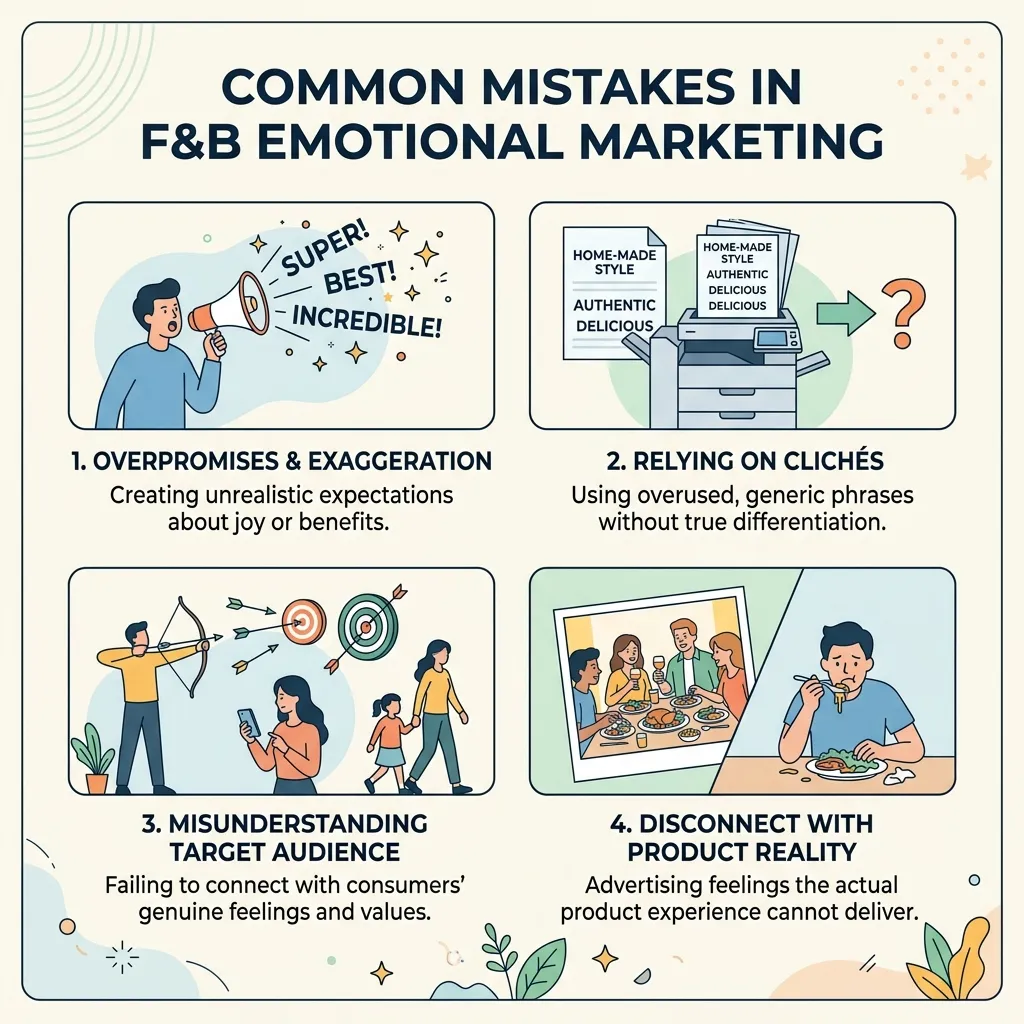
- Leaning on nostalgia or sentimentality without a genuine story behind it, which reads as manufactured rather than earned
- Ignoring packaging as an emotional touchpoint and treating it as purely functional
- Overpromising an emotional experience the product itself doesn’t actually deliver
- Using guilt-based messaging around indulgence instead of positioning treats as a positive, permissible choice
- Neglecting trust signals like sourcing and transparency, which matter more in food than almost any other category
Conclusion
Emotional marketing for food & beverage brands isn’t a separate campaign layered on top of your product — it’s the lens through which nearly every decision, from packaging color to social captions, should be evaluated. Nostalgia, comfort, belonging, indulgence, and trust aren’t abstract concepts; they’re the actual reasons people choose one snack, drink, or meal over another when the functional differences are small.
Brands that consistently identify the right emotion for their product, reflect it honestly across packaging and storytelling, and resist the temptation to manufacture sentiment they haven’t earned tend to build the kind of loyalty that outlasts any single campaign. In a category this personal, feeling understood is often the deciding factor between a one-time purchase and a lifelong customer.
Frequently Asked Questions About Emotional Marketing in Food and Beverage
1. What Is Emotional Marketing in the Food and Beverage Industry?
Emotional marketing in food and beverage is the practice of positioning products around feelings like nostalgia, comfort, or belonging rather than only functional benefits like taste or price.
2. Why Does Nostalgia Marketing Work So Well for Food Brands?
Nostalgia can evoke positive memories and increase feelings of social connection, which can make a product feel familiar and appealing when a shopper is deciding what to buy.
3. How Does Packaging Design Affect Emotional Marketing?
Packaging is often the first emotional signal a shopper receives, with color, texture, and typography all shaping perception before the product is even tasted.
4. Which Emotion Works Best for Food and Beverage Brands?
It depends on the product. Indulgent snacks often lean on comfort and reward, while functional beverages may focus more on trust, energy, or belonging.
5. Can Small Food Brands Compete With Big Brands Using Emotional Marketing?
Yes. Small brands can have an advantage because genuine founder stories and authentic origins can create personal connections that larger, more corporate brands may find harder to replicate.
6. What Channels Work Best for Emotional Food Marketing?
Short-form video and imagery-heavy platforms can work particularly well because visuals such as texture, pouring, preparation, and steam can create an immediate sensory connection with audiences.
7. Is Emotional Marketing Manipulative?
Emotional marketing can become misleading when the emotions promised are not genuinely reflected in the product or brand story. Authentic emotional marketing helps customers understand what makes a brand meaningful to them.
8. How Important Is Storytelling for Food and Beverage Brands?
Storytelling can be highly valuable because an honest origin story gives shoppers a reason to care beyond ingredients and price and can contribute to stronger long-term brand relationships.
9. Does Color Really Affect Food Purchasing Decisions?
Yes. Color choices in packaging can influence consumer perceptions and carry psychological associations. For example, red is often associated with energy or appetite, while green can suggest freshness or natural qualities.
10. How Can I Measure Whether My Emotional Marketing Is Working?
Track metrics such as repeat purchase rates, social shares, comments that reference specific emotions, branded search volume, and standard conversion metrics to evaluate campaign performance.
11. Should Indulgent Food Brands Avoid Discussing Guilt?
Brands should consider whether guilt-based messaging aligns with their audience and positioning. Positive framing around enjoyment, reward, or moderation may create a more appealing experience for indulgent products.
12. How Does Trust Function as an Emotional Trigger in Food Marketing?
Because people consume food and beverages directly, transparency about sourcing, ingredients, and consistent quality can reduce uncertainty and build a stronger sense of trust and safety around the brand.