Social Proof Psychology in Marketing: The Complete Guide
Social proof psychology in marketing taps into deeply human instincts—our need for validation, belonging, and certainty. When brands display reviews, expert endorsements, and user-generated content, they reduce purchase anxiety and accelerate buying decisions. This guide explains the science behind it and how to use it strategically.
Few forces in marketing are as quietly powerful as social proof. Every five-star review, every “10,000 customers served” badge, every celebrity endorsement—these signals do more than decorate a webpage. They rewire how potential customers feel about a purchase before they’ve even made a conscious decision.
Social proof psychology in marketing isn’t a new concept. Robert Cialdini introduced it in his landmark 1984 book Influence: The Psychology of Persuasion, identifying social proof as one of six core principles of persuasion. Decades later, the principle has only grown in relevance. According to BrightLocal’s 2023 Local Consumer Review Survey, 98% of consumers read online reviews for local businesses—up from 77% in 2019. The psychology hasn’t changed. The channels have multiplied.
This guide covers everything: the emotional mechanics that make social proof work, the six main types marketers use, how to implement them effectively, and how emotion recognition in marketing and customer emotion mapping can sharpen your campaigns. You’ll also find a section on emotional triggers in SEO content, real-world case studies, and ethical guardrails to keep your strategy trustworthy.
Whether you’re building an e-commerce brand, a SaaS product, or a service business, understanding social proof psychology in marketing could be the highest-leverage shift you make this year.
What Is Social Proof, and Why Does It Matter So Much?
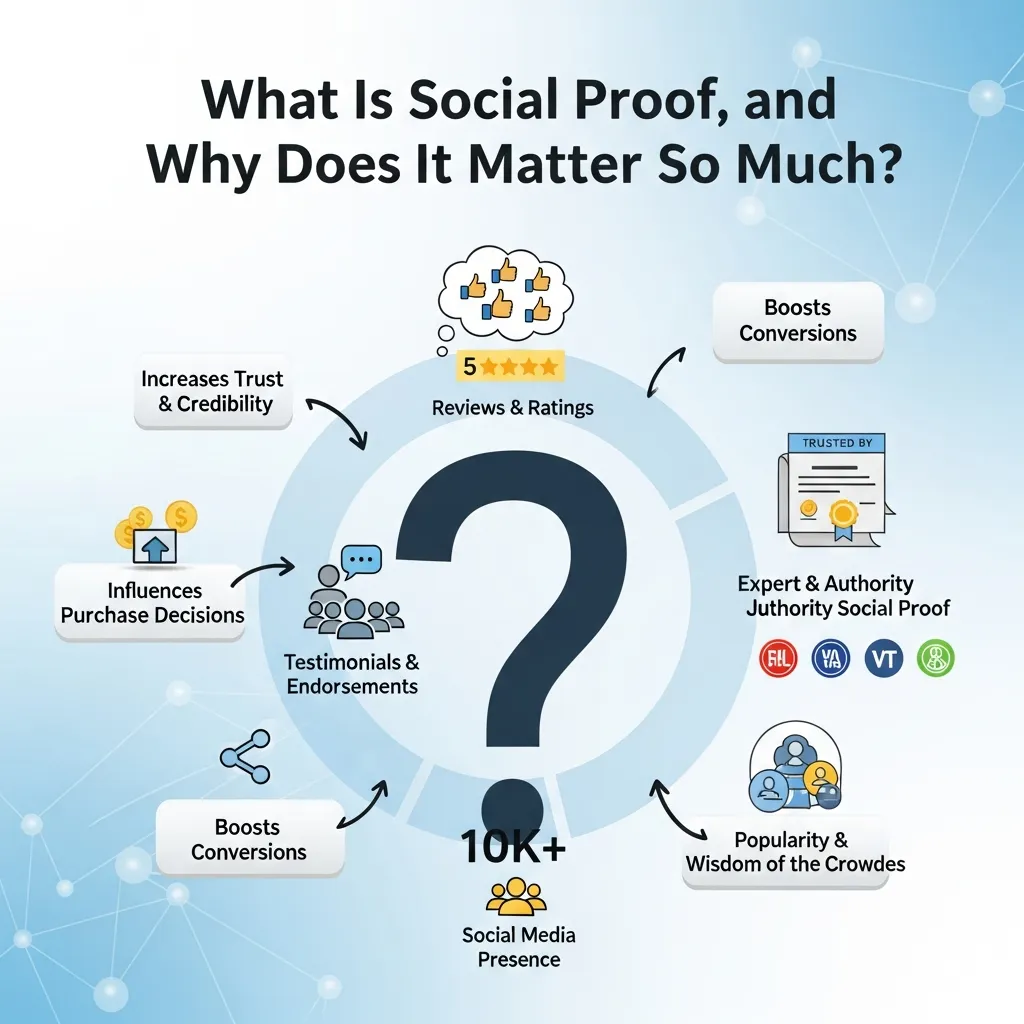
Social proof is the psychological phenomenon where people look to the behavior and opinions of others to determine the correct course of action—especially in uncertain situations. When a shopper doesn’t know which protein powder actually works, they read the reviews. When a startup evaluates three project management tools, the G2 rating nudges the decision.
The principle rests on a simple assumption: if other people are doing it, it’s probably the right thing to do. This heuristic saves cognitive energy, which the human brain is constantly trying to conserve.
In today’s market—saturated with options, fragmented across channels, and clouded by competing claims—social proof functions as a trust shortcut. Brands that use it well don’t just attract more customers; they reduce the friction that stands between interest and purchase.
The interplay of social proof and consumer psychology
Social proof doesn’t operate in isolation. It sits at the intersection of several psychological principles: conformity bias, authority bias, the bandwagon effect, and loss aversion. These forces compound each other. A product with thousands of reviews activates conformity bias. A product endorsed by a recognized expert activates authority bias. Together, they create a persuasive environment that’s much stronger than either signal alone.
The Psychology Behind Social Proof: Emotional Decision Making Shapes Every Purchase
The human need for validation and belonging
Humans are fundamentally social creatures. Neuroscience research shows that social exclusion activates the same neural pathways as physical pain (Eisenberger, Lieberman & Williams, Science, 2003). Belonging isn’t a preference—it’s a biological need. Social proof satisfies this need by signaling that a choice is socially accepted, even socially celebrated.
When emotional decision making shapes every purchase, as it invariably does, the question shifts from “Is this product good?” to “Will choosing this make me feel part of the right group?” Social proof answers that second question directly.
How uncertainty drives conformity
Uncertainty amplifies social proof’s power. The more ambiguous a decision, the more people defer to others. This is why new product categories—electric vehicles, AI software tools, novel health supplements—lean so heavily on early adopters and testimonials. The early social proof establishes a behavioral template for everyone who comes after.
Cognitive biases amplified by social proof
Several cognitive biases interact with social proof psychology in marketing:
- Bandwagon effect: The more popular something appears, the more desirable it becomes.
- Herding bias: People assume collective wisdom outperforms individual judgment.
- Authority bias: Endorsements from credentialed experts carry disproportionate weight.
- Recency bias: Fresh reviews matter more than older ones, which affects how platforms should curate testimonials.
Market fluctuation emotions and consumer behavior
Market fluctuation emotions—anxiety, uncertainty, FOMO—are underappreciated drivers of social proof effectiveness. During economic downturns or volatile markets, consumers become more risk-averse. They seek more validation before spending. This makes social proof especially powerful during uncertain economic periods. Brands that maintain consistent review-generation practices during downturns create a visible trust reservoir precisely when buyers need it most.
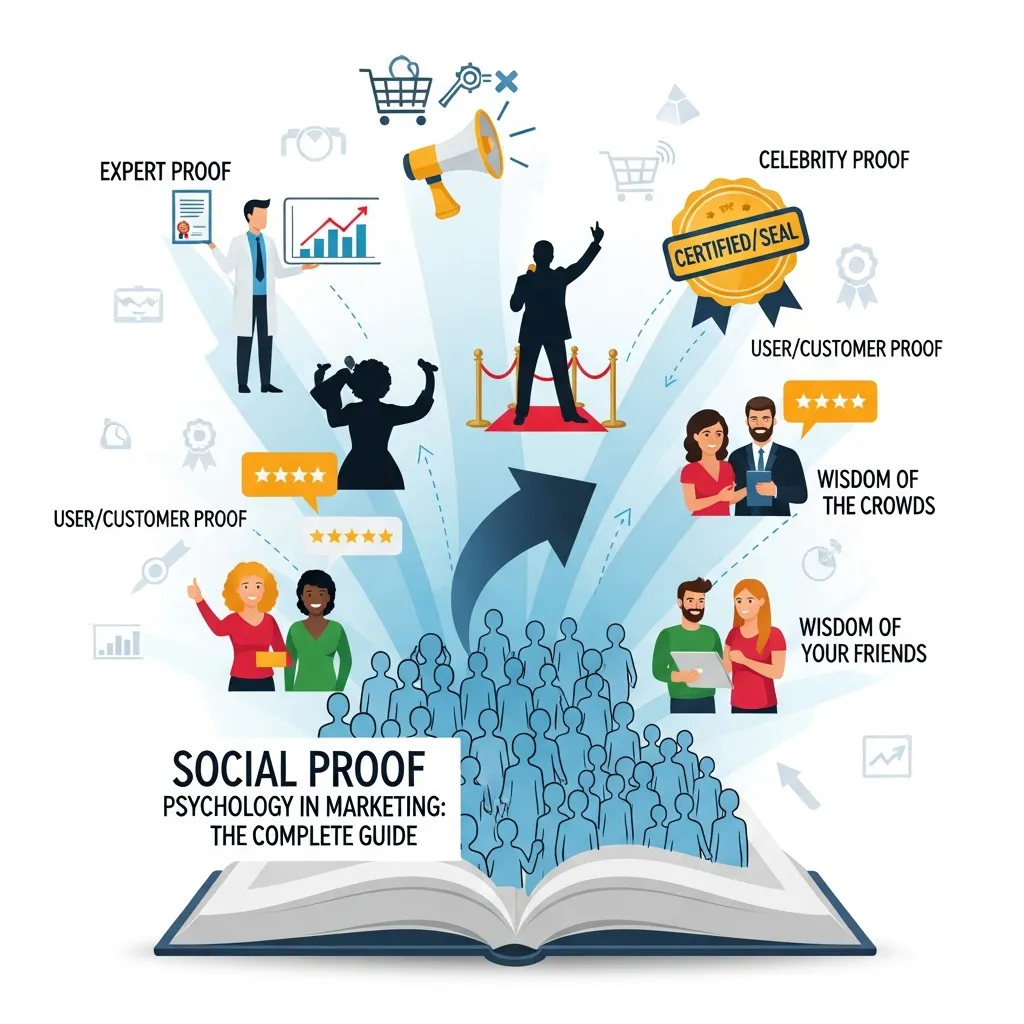
The Six Types of Social Proof in Marketing
Expert social proof
Endorsements or citations from recognized authorities in a field. Think dermatologist-recommended skincare, cybersecurity certifications on SaaS platforms, or a nutritionist quoted in a health brand’s marketing materials. Expert social proof is particularly effective in high-stakes or high-complexity categories.
Celebrity social proof
Public figures lending their credibility or image to a brand. When executed authentically—meaning the celebrity genuinely uses or aligns with the product—celebrity social proof can generate massive awareness and emotional association. Misaligned partnerships, however, backfire quickly.
User and customer social proof
This is the broadest and most democratic category: testimonials, written reviews, star ratings, video case studies, and before-and-after stories. According to Spiegel Research Center, displaying reviews can increase conversion rates by up to 270%. The power lies in relatability—a review from someone who resembles the prospective buyer carries enormous weight.
Wisdom of the crowds
Signals of popularity: “Over 1 million sold,” “Best-seller,” “Trending now.” These signals activate bandwagon psychology and reassure buyers that they’re making a mainstream, validated choice. Amazon’s “Best Seller” badge is a textbook example.
Wisdom of your friends
Social sharing metrics, mutual connections who follow or endorse a brand, or Facebook showing that three of your friends liked a page. This form of social proof is hyper-personalized and highly effective because people weight the opinions of people they know above strangers.
Certification and accreditation social proof
Third-party stamps of approval: ISO certifications, BBB accreditation, industry awards, verified badges. These reduce perceived risk, particularly in B2B markets and regulated industries.
How to Implement Social Proof in Your Marketing Strategy
Leveraging testimonials and reviews effectively
Don’t just collect reviews—curate and place them strategically. High-stakes pages (pricing, checkout, landing pages) benefit most from visible social proof. Use specific testimonials that address common objections. A testimonial that says “I was worried about the price, but the ROI was clear within three weeks” is far more persuasive than a generic five-star rating.
Showcasing user-generated content
User-generated content (UGC) functions as unpaid, authentic advertising. Encourage customers to share photos, videos, or posts using a branded hashtag. Feature this content on product pages, email campaigns, and social channels. According to Nielsen, 92% of consumers trust organic UGC more than traditional advertising.
Highlighting social media engagement
High follower counts, strong engagement rates, and reshares signal credibility. Display these metrics prominently where relevant. A SaaS product page that notes “Trusted by 25,000 marketing teams” is leveraging crowd wisdom effectively.
Partnering with influencers and experts
Micro-influencers—those with 10,000 to 100,000 followers—often outperform mega-influencers in engagement and conversion, particularly in niche categories. Align influencer partnerships with genuine product-fit to preserve authenticity.
Displaying certifications and awards
Add trust badges, industry certifications, and award placements near conversion points. On e-commerce sites, security certifications near checkout pages reduce cart abandonment.
Creating a sense of urgency and popularity
Real-time social proof—”47 people are viewing this right now” or “Only 3 left in stock”—combines social validation with scarcity to accelerate decisions. Use sparingly and only when accurate, to avoid undermining trust.
Emotion Recognition in Marketing and Customer Emotion Mapping
Understanding the role of emotions in purchasing decisions
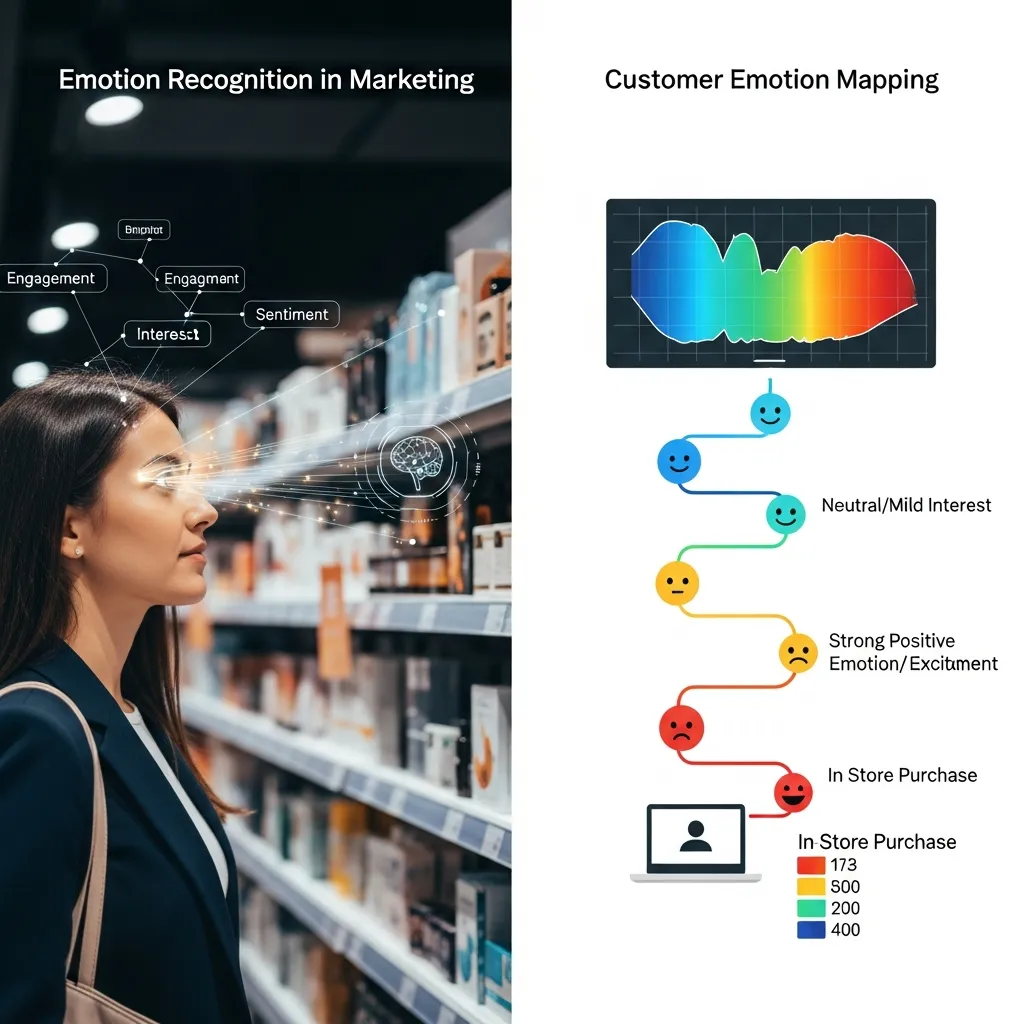
Neuroscientist Antonio Damasio’s somatic marker hypothesis established that emotions aren’t just byproducts of decisions—they’re prerequisites for them. People with damage to emotional-processing brain regions struggle to make even simple choices. Emotion recognition in marketing acknowledges this reality and builds campaigns around emotional states rather than purely rational arguments.
Tools and techniques for emotion recognition
Modern emotion recognition in marketing uses several approaches:
- Facial coding software (e.g., Affectiva, iMotions) analyzes micro-expressions during ad exposure to gauge emotional response.
- Eye-tracking technology maps attention and identifies emotionally resonant content zones.
- Sentiment analysis tools process text reviews and social media comments to detect emotional tone at scale.
- Biometric response measurement tracks heart rate variability and galvanic skin response during product experiences.
How to map customer emotions throughout the buyer’s journey
Customer emotion mapping charts how a buyer feels at each stage—awareness, consideration, decision, post-purchase. Different emotions dominate different stages:
- Awareness: Curiosity, aspiration
- Consideration: Uncertainty, comparison anxiety
- Decision: Risk aversion, anticipation
- Post-purchase: Satisfaction or regret (affecting loyalty and reviews)
Social proof can be calibrated to each stage. During consideration, peer reviews reduce anxiety. At the decision stage, limited-time social indicators create urgency. Post-purchase, community belonging reduces buyer’s remorse and encourages positive reviews—feeding the cycle.
Using emotional data to enhance social proof strategies
Once emotional data reveals where buyers feel most uncertain or most excited, marketers can insert the right type of social proof at the right moment. A SaaS company discovering that trial users feel anxious during onboarding might add a customer success story on the day-three onboarding email. Emotional data makes social proof placement precise rather than speculative.
Emotional Triggers in SEO Content and Social Proof
Crafting SEO content that resonates emotionally
Emotional triggers in SEO content extend beyond keywords. Headlines that evoke curiosity (“Why 73% of shoppers abandon checkout—and how to stop them”) or address fear (“The silent mistake costing your brand reviews”) outperform purely informational titles in click-through rates. According to CoSchedule’s headline analysis data, emotional headlines generate significantly higher engagement than neutral ones.
Words like “proven,” “trusted,” “guaranteed,” and “award-winning” trigger positive emotional associations and align naturally with social proof language.
How social proof signals influence search rankings
Google’s quality rater guidelines emphasize E-E-A-T: Experience, Expertise, Authoritativeness, and Trustworthiness. Social proof contributes to all four dimensions. Third-party reviews, expert citations, awards, and high engagement metrics signal credibility to both users and search algorithms. Review schema markup, in particular, generates rich snippets—star ratings in search results—that improve click-through rates.
Integrating emotional language with social proof elements
Pair quantitative social proof (“4.9 stars across 12,000 reviews”) with qualitative emotional language (“Our customers describe it as life-changing”). The number satisfies the logical brain; the emotional language resonates with how people actually experience the product.
Measuring the impact of emotional triggers on engagement
Track time-on-page, scroll depth, and social shares for content featuring emotional triggers versus neutral content. Heatmapping tools (Hotjar, Microsoft Clarity) reveal which social proof elements attract the most attention. A/B testing emotional headline variations against neutral ones quantifies the engagement lift.
Case Studies: Social Proof Psychology in Marketing Done Right
E-commerce: Glossier
Glossier built its brand almost entirely on customer social proof psychology in marketing. Rather than traditional advertising, the brand amplified UGC from real customers, built a community of brand advocates, and featured authentic skin photos instead of retouched models. The result: a cult following and over $1.8 billion valuation before its 2023 funding rounds.
SaaS: Slack
Slack’s homepage prominently features company logos of well-known clients alongside usage statistics (“Over 10 million daily active users”). This form of wisdom-of-the-crowds social proof—combined with enterprise credibility signals—reduces the evaluation friction that B2B buyers face. Slack grew to 10 million DAUs in four years partly on the strength of visible adoption metrics.
Service-based businesses: Airbnb
Airbnb built its entire trust infrastructure on social proof: two-way host-and-guest reviews, verified identity badges, Superhost status, and photo ratings. Without these signals, the premise of staying in a stranger’s home would be psychologically untenable for most people. The review system made the unfamiliar feel safe.
Measuring the Effectiveness of Social Proof Campaigns
Key performance indicators for social proof
- Conversion rate lift from pages featuring testimonials versus those without
- Review volume and average star rating over time
- UGC volume and reach
- Time-on-page for review-rich content
- Cart abandonment rate on pages with versus without trust badges
Analytics and attribution models
Multi-touch attribution models help identify which social proof elements contribute to conversion across the funnel. A customer who saw an influencer post, then read three product reviews, then converted after seeing a “Best Seller” badge—that journey tells you which social proof types work at which stages.
A/B testing social proof elements
Test placement, format, and type. Does a video testimonial outperform a written one? Does a trust badge near the checkout button reduce abandonment? Does showing a review count increase or decrease credibility depending on the category? Systematic testing turns intuition into evidence.
Ethical Considerations: Keeping Social Proof Trustworthy
Authenticity and transparency
Fabricated reviews, inflated follower counts, or misleading “as seen on” badges aren’t just unethical—they’re increasingly illegal. The FTC’s updated endorsement guidelines (2023) require clear disclosure of paid partnerships and material connections. Transparency protects brands from regulatory risk and, more importantly, preserves the long-term trust that social proof depends on.
Avoiding manipulation
There’s a meaningful line between surfacing genuine social proof and manufacturing false urgency or popularity. “Only 2 left!” when inventory is abundant, or “23 people viewing this” when traffic is low, erodes trust when customers catch on—and they increasingly do.
Maintaining trust as a long-term asset
Social proof psychology in marketing is most powerful when it’s true. Real reviews, real communities, real endorsements—these compound over time into a brand reputation that resists competitive pressure. Trust is the one marketing asset that no budget can buy outright; it must be earned, one customer experience at a time.
The Long Game: Building a Social Proof Strategy That Lasts
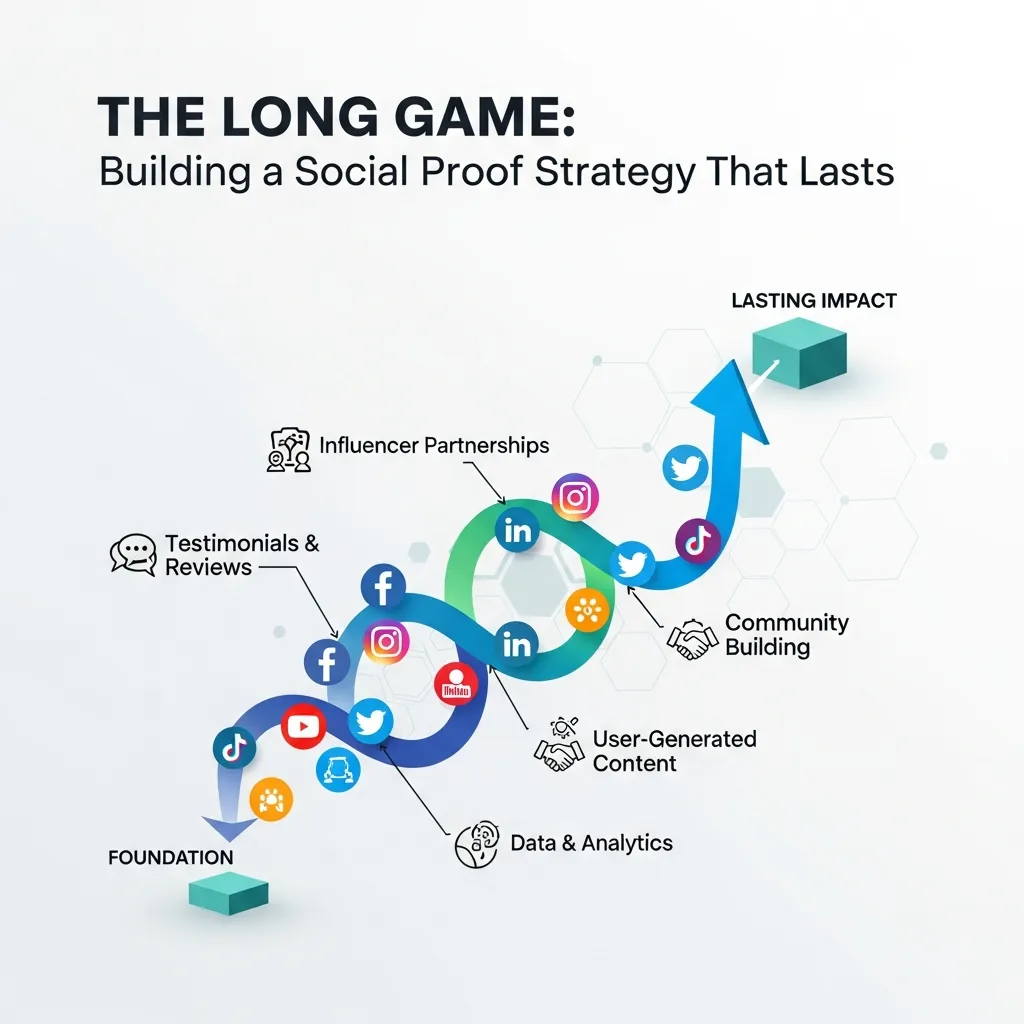
Social proof psychology in marketing isn’t a tactic to deploy once—it’s a system to build continuously. Every satisfied customer is a potential advocate. Every review is a conversion asset. Every piece of user-generated content is authentic marketing that costs you nothing but a great product experience.
Start by auditing what social proof you already have and where you’re placing it. Then map your customer’s emotional journey to identify where uncertainty peaks—and meet it with the right proof at the right moment. Use emotion recognition in marketing tools to move beyond guesswork. Integrate emotional triggers in SEO content to extend your reach. And measure everything.
The brands that win aren’t necessarily those with the best products. They’re often the ones that make their quality most visible, most credible, and most emotionally resonant.
FAQs About Social Proof Psychology in Marketing
1. What is Social Proof Psychology in Marketing?
Social Proof Psychology in Marketing is the strategy of using reviews, testimonials, ratings, endorsements, and popularity signals to influence buying decisions. It works because people naturally look at what others trust or recommend before making their own choice.
2. Why does Social Proof Psychology in Marketing work so well?
Social Proof Psychology in Marketing works because it reduces uncertainty and builds trust. When customers see that other people had a positive experience, they feel more confident and are more likely to make a purchase.
3. How does emotion connect with Social Proof Psychology in Marketing?
Emotion plays a major role in Social Proof Psychology in Marketing because buying decisions are often shaped by trust, fear, excitement, and social validation. Reviews and testimonials reduce anxiety, while popularity signals can create FOMO and confidence.
4. What are the most effective types of Social Proof Psychology in Marketing for e-commerce?
For e-commerce, the strongest forms of Social Proof Psychology in Marketing usually include customer reviews, star ratings, user-generated content, trust badges, and real-time purchase notifications. These forms of proof help shoppers feel safer and more motivated to buy.
5. What is customer emotion mapping, and how does it improve Social Proof Psychology in Marketing?
Customer emotion mapping helps brands understand how customers feel at each stage of the buying journey. This improves Social Proof Psychology in Marketing by showing where reviews, testimonials, or trust signals should appear to have the biggest emotional impact.
6. How does emotion recognition support Social Proof Psychology in Marketing?
Emotion recognition tools help marketers understand how audiences react to content, ads, and product pages. These insights make Social Proof Psychology in Marketing more effective by revealing which types of reviews, endorsements, or proof create the strongest response.
7. How do economic changes affect Social Proof Psychology in Marketing?
During uncertain times, Social Proof Psychology in Marketing becomes even more important because buyers want more reassurance before spending money. Strong reviews, trust signals, and visible customer satisfaction can reduce risk and increase confidence.
8. Can Social Proof Psychology in Marketing improve SEO performance?
Yes, Social Proof Psychology in Marketing can support SEO by increasing click-through rates, building trust, and creating fresh user-generated content. Review schema, ratings in search results, and customer testimonials can all improve visibility and engagement.
9. What KPIs should measure Social Proof Psychology in Marketing?
To measure Social Proof Psychology in Marketing, track conversion rate, review volume, average ratings, click-through rate, engagement on user-generated content, and cart abandonment rate. A/B testing is also useful for seeing which type of social proof performs best.
10. Is Social Proof Psychology in Marketing ethical?
Yes, Social Proof Psychology in Marketing is ethical when the proof is real and transparent. Brands should use genuine reviews, clearly disclose paid endorsements, and avoid fake ratings, false urgency, or misleading popularity claims.
11. Does Social Proof Psychology in Marketing work in every industry?
Yes, Social Proof Psychology in Marketing works across almost every industry, but the format changes. E-commerce often relies on reviews and ratings, B2B uses case studies and client logos, while healthcare and finance depend more on expert proof and trust signals.
12. What is the biggest benefit of Social Proof Psychology in Marketing?
The biggest benefit of Social Proof Psychology in Marketing is that it builds trust faster. It helps potential customers feel safer, reduces hesitation, and increases the chance of conversion by showing that others already believe in the product or service.