Customer Emotion Mapping: A Guide to Winning Hearts
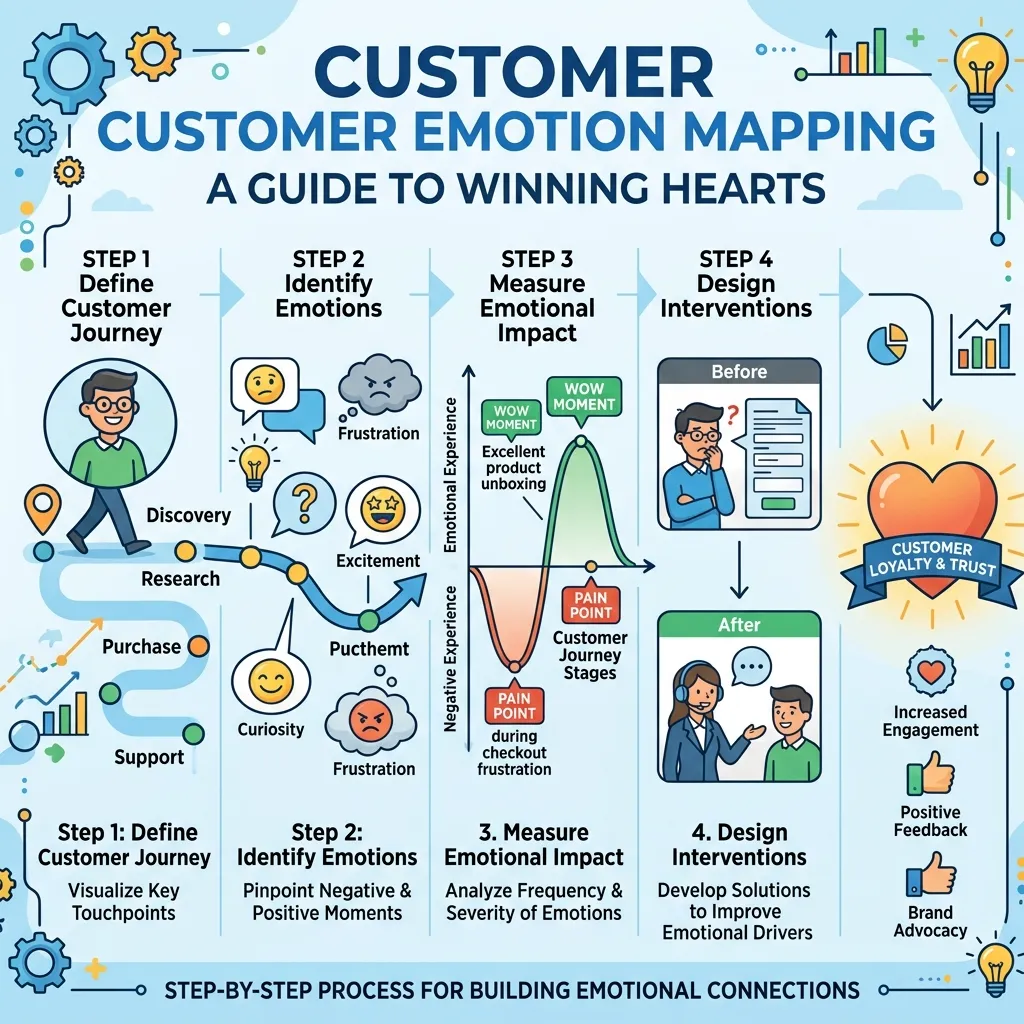
Customer Emotion Mapping is the practice of tracking and visualizing how customers feel at every stage of their journey with your brand. By identifying emotional highs and lows, businesses can fix pain points, build loyalty, and create memorable experiences that drive long-term growth.
Most buying decisions aren’t purely logical. Research from Harvard Business School professor Gerald Zaltman suggests that 95% of purchasing decisions happen subconsciously, driven largely by emotion. That means if you only track clicks, conversions, and survey scores, you’re missing the bigger picture—how your customers actually feel.
Customer Emotion Mapping fills that gap. It helps you see your brand through your customers’ eyes, capturing their frustration, delight, confusion, and trust at each touchpoint. Once you understand those feelings, you can design experiences that resonate on a deeper level.
This guide breaks down what Customer Emotion Mapping is, why it matters, and how to put it into practice. You’ll learn how to gather emotional data, build an Emotional Branding Strategy, strengthen your Emotional Brand Experience, and use Customer Support Services to turn tough moments into loyalty-building wins. Whether you’re refining an existing program or starting from scratch, you’ll walk away with actionable steps.
What Is Customer Emotion Mapping?
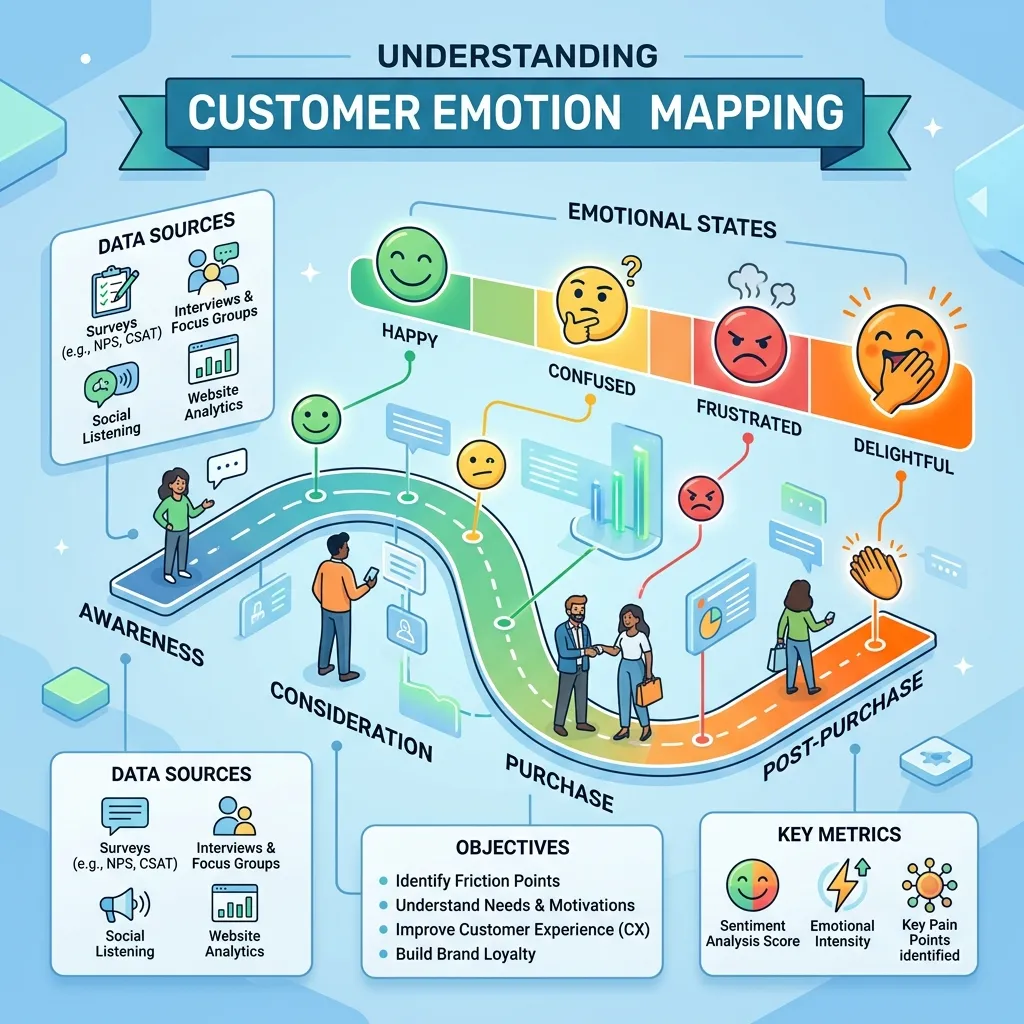
Customer Emotion Mapping is a method for identifying, recording, and visualizing the emotions customers feel as they interact with your brand. It goes beyond standard journey mapping, which often focuses on actions and steps. Instead, Customer Emotion Mapping zeroes in on the feelings behind those actions.
Picture a customer signing up for a software trial. Traditional mapping records the steps: visit homepage, click sign-up, complete form. Customer Emotion Mapping adds another layer—excitement at discovery, mild anxiety during form-filling, relief when onboarding feels smooth. Those emotional shifts reveal where you build trust and where you risk losing people.
Why Customer Emotion Mapping matters for businesses
Emotions drive behavior. A customer who feels valued is far more likely to return, recommend you to friends, and forgive the occasional mistake. According to research published in the Harvard Business Review, emotionally connected customers are more than twice as valuable as highly satisfied customers. They buy more, visit more often, and show greater loyalty.
Customer Emotion Mapping gives you a clear view of those connections. It highlights moments of delight worth amplifying and moments of friction worth fixing. Without this insight, businesses often pour resources into the wrong areas, polishing features customers don’t care about while ignoring the parts that frustrate them.
How customer experience shifted from logic to emotion
For decades, companies competed on price, features, and convenience. Those things still matter, but they’re now table stakes. As markets crowded and products grew similar, emotion became the real differentiator. Today, customers expect brands to understand them, anticipate their needs, and treat them like people rather than transactions. Customer Emotion Mapping is the tool that makes this possible at scale.
What Are the Fundamentals of Customer Emotion Mapping?
Before you can map emotions, you need a solid foundation. Three building blocks make Customer Emotion Mapping effective: clear touchpoints, quality emotional data, and a way to visualize it all.
How do you identify key customer touchpoints?
Start by listing every point where a customer interacts with your brand. This includes obvious moments like a purchase or a support call, plus subtler ones like reading a review, opening an email, or seeing an ad. Group these into stages such as awareness, consideration, purchase, onboarding, and retention. Each stage carries its own emotional weight, and naming them gives your map a clear structure.
How do you gather emotional data?
You can’t map what you don’t measure. Several methods help you capture how customers feel:
- Surveys: Add emotion-focused questions, such as “How did this experience make you feel?” rather than only rating satisfaction on a scale.
- Interviews: One-on-one conversations reveal nuance and context that surveys miss. Ask customers to describe specific moments and the feelings attached to them.
- Observational studies: Watch how customers behave in real time. Facial expressions, hesitation, and tone of voice often reveal emotions people won’t state outright.
- Support and review analysis: Mine your support tickets, chat logs, and online reviews for emotional language. Words like “frustrated,” “love,” or “confused” are gold.
What tools and techniques help you visualize emotions?
Once you’ve gathered data, plot it on a visual map. A common approach uses a curved line that rises and falls across journey stages, showing emotional highs and lows. Tools like Miro, Smaply, and UXPressia make this easier, and even a simple spreadsheet works for smaller teams. The goal is a shared picture your whole team can rally around.
How Does Emotional Memory in Marketing Work?
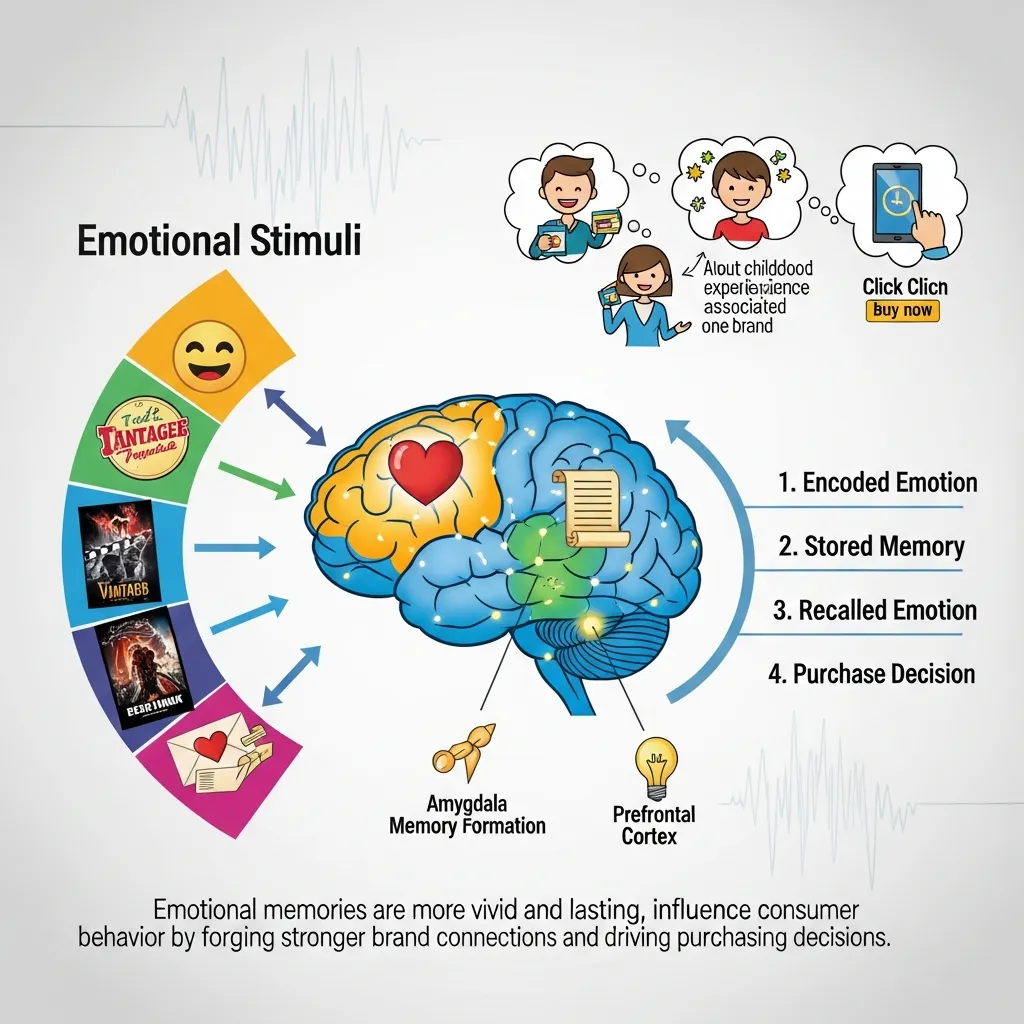
People remember how you made them feel long after they forget what you said. Emotional Memory in Marketing taps into this truth, helping brands create experiences that stick.
How emotions influence customer recall and loyalty
Our brains prioritize emotionally charged events. A delightful surprise or a moment of genuine care imprints far more deeply than a routine transaction. This is why Emotional Memory in Marketing matters so much—it turns ordinary interactions into lasting impressions that drive repeat business.
Creating memorable experiences
Small, thoughtful touches create outsized emotional impact. A handwritten thank-you note, a surprise upgrade, or a quick personalized video can transform a customer’s perception. The brand that adds a human touch stands out in a sea of automated messages. These moments feed directly into your Emotional Brand Experience and become stories customers love to share.
The power of storytelling in evoking emotion
Stories activate emotion in ways that facts alone never can. When you frame your brand around a relatable narrative—a problem solved, a hero supported, a goal reached—you give customers something to feel. Strong storytelling strengthens Emotional Memory in Marketing by wrapping your message in feeling, making it easier to recall and repeat.
How Do You Build an Emotional Branding Strategy?
An Emotional Branding Strategy connects your brand to the feelings you want customers to associate with you. Done well, it creates a bond that price and features can’t break.
Defining your brand’s emotional core
Start by asking what your brand stands for and how you want people to feel when they encounter it. Comfort? Confidence? Excitement? Belonging? This emotional core becomes the anchor for every decision in your Emotional Branding Strategy, from your tone of voice to your packaging.
Aligning brand messaging with customer emotions
Your messaging should reflect the emotions your customers feel and the ones you want to inspire. If your Customer Emotion Mapping reveals anxiety during onboarding, your messaging at that stage should be reassuring and supportive. Alignment between what customers feel and what you say builds trust quickly.
Building emotional connections through brand narratives
A consistent narrative ties your Emotional Branding Strategy together. Share customer success stories, the reason you started, and the values you hold. When customers see their own hopes reflected in your story, they form a connection that goes beyond the product itself.
How Do You Enhance the Emotional Brand Experience?
The Emotional Brand Experience is the sum of every feeling a customer has across all interactions. Improving it requires intention at each step.
Personalization and emotional resonance
Personalization signals that you see customers as individuals. Recommending products based on past behavior, addressing people by name, and remembering preferences all deepen emotional resonance. A tailored Emotional Brand Experience feels less like marketing and more like a relationship.
The role of sensory experiences in emotion
Sight, sound, touch, and even smell shape how customers feel. A clean, calming website design, a satisfying unboxing, or a signature scent in a retail store all contribute to the Emotional Brand Experience. These sensory cues work quietly but powerfully on emotion.
Measuring and optimizing the Emotional Brand Experience
What gets measured gets improved. Track metrics like Net Promoter Score, customer effort score, and sentiment analysis to gauge emotional health. Pair these numbers with qualitative feedback to spot trends, then refine your approach. Optimizing the Emotional Brand Experience is an ongoing cycle, not a one-time project.
What Role Do Customer Support Services Play in Managing Emotions?
Customer Support Services often handle customers at their most emotional—when something has gone wrong. That makes support a make-or-break moment for loyalty.
Turning negative experiences into positive outcomes
A well-handled complaint can build more loyalty than a flawless experience. When Customer Support Services respond with empathy, speed, and a real solution, frustrated customers often become your biggest advocates. This “service recovery paradox” shows how powerful emotional repair can be.
Empowering support teams to address emotional needs
Give your support team permission to be human. Scripts have their place, but rigid rules can frustrate customers who need understanding. Train Customer Support Services to recognize emotional cues and respond with genuine care, and give them the authority to make things right.
Proactive customer support in managing emotions
The best Customer Support Services don’t wait for problems. They reach out before frustration builds—flagging a shipping delay, checking in after a complex setup, or offering help when usage drops. Proactive support shows customers you care, strengthening the Emotional Brand Experience before issues escalate.
How Do You Implement Customer Emotion Mapping Step by Step?
Ready to build your own map? Follow these three steps to move from theory to action.
Step 1: Define your customer journey stages
Break the journey into clear stages, from first awareness to long-term loyalty. Keep the stages broad enough to manage but specific enough to be useful. This structure becomes the backbone of your Customer Emotion Mapping.
Step 2: Identify emotional highs and lows
Using your gathered data, mark the emotional peaks and valleys at each stage. Where do customers feel delighted? Where do they feel stuck or frustrated? Plot these clearly so the pattern jumps off the page.
Step 3: Develop actionable insights and strategies
A map is only useful if it leads to action. For each emotional low, brainstorm fixes. For each high, find ways to amplify it. Assign owners, set deadlines, and track results. This turns Customer Emotion Mapping from a pretty diagram into a growth engine.
What Are the Advanced Techniques in Customer Emotion Mapping?

Once you’ve mastered the basics, these advanced techniques sharpen your insight.
Predictive emotion analytics
Predictive analytics uses historical data to forecast how customers will feel in future scenarios. By spotting patterns, you can intervene before negative emotions take hold—reaching out to at-risk customers before they churn.
AI and machine learning in understanding customer emotions
AI tools can analyze huge volumes of text, voice, and even facial data to detect emotion at scale. Sentiment analysis software scans reviews and chats, while voice analytics gauge tone during calls. These tools make Customer Emotion Mapping faster and more precise across thousands of interactions.
Cross-channel emotional consistency
Customers move between your website, app, social media, and support channels. Emotional consistency across all of them matters. A warm, helpful tone in one channel and a cold, robotic one in another creates confusion. Cross-channel mapping ensures a unified Emotional Brand Experience everywhere.
What Are the Challenges and Best Practices in Customer Emotion Mapping?
Like any strategy, Customer Emotion Mapping has pitfalls. Knowing them helps you avoid costly mistakes.
Common pitfalls to avoid
- Assuming instead of asking: Don’t guess how customers feel—gather real data.
- Mapping once and forgetting: Emotions change, so your map should evolve too.
- Ignoring the negative: It’s tempting to focus on highs, but the lows hold the biggest opportunities.
Tips for successful implementation
Involve cross-functional teams so marketing, product, and Customer Support Services all share ownership. Start small with one journey, prove the value, then expand. Keep your map visible so it stays top of mind.
Continuous improvement and adaptation
Treat Customer Emotion Mapping as a living practice. Revisit your map regularly, update it with fresh data, and adjust your strategies as customer expectations shift. Continuous refinement keeps your Emotional Brand Experience strong over time.
What Do Real-World Case Studies Teach Us?
Companies across industries use emotion mapping to drive results. In retail, brands map the unboxing experience to maximize delight at delivery. In hospitality, hotels track guest emotions from booking to checkout, smoothing friction at check-in. In SaaS, software companies map onboarding emotions to reduce early churn.
The common lesson? The brands that win pay close attention to emotional lows and act fast to fix them. They also double down on the highs, turning small moments of joy into signature experiences. Across every industry, pairing emotional insight with responsive Customer Support Services produces the strongest loyalty.
What Are the Future Trends in Customer Emotion Mapping?

Customer Emotion Mapping keeps evolving. Three trends stand out.
The rise of empathetic AI
AI is getting better at recognizing and responding to human emotion. Empathetic AI can adjust its tone based on a customer’s mood, offering support that feels surprisingly human. This will make real-time emotional response possible at scale.
Hyper-personalization and emotional intelligence
Brands are moving toward experiences tailored to each individual’s emotional state. Combining behavioral data with emotional insight, hyper-personalization will deliver the right message, in the right tone, at exactly the right moment.
Ethical considerations in emotional marketing
With great insight comes great responsibility. Using emotional data to manipulate rather than serve customers erodes trust fast. The brands that thrive will use Customer Emotion Mapping transparently and respectfully, always putting the customer’s well-being first.
Turning Feelings Into Loyalty
Customer Emotion Mapping transforms guesswork into clarity. By understanding how customers feel at every step, you can fix friction, amplify joy, and build connections that last. The payoff is real—emotionally connected customers spend more, stay longer, and champion your brand to others.
Start small. Pick one customer journey, gather honest emotional data, and plot the highs and lows. Use those insights to shape your Emotional Branding Strategy, enrich your Emotional Brand Experience, and empower your Customer Support Services to respond with empathy. Over time, these efforts compound into a brand customers genuinely love.
The companies that master Customer Emotion Mapping won’t just satisfy customers—they’ll move them. And in a crowded market, emotion is the advantage that’s hardest to copy.
Frequently Asked Questions
What is the primary goal of Customer Emotion Mapping?
The primary goal of Customer Emotion Mapping is to understand how customers feel at each stage of their journey so businesses can improve experiences, reduce friction, and build stronger loyalty. It turns invisible emotions into visible, actionable insight.
How does Customer Emotion Mapping differ from traditional customer journey mapping?
Traditional journey mapping focuses on the steps and actions a customer takes. Customer Emotion Mapping adds an emotional layer, capturing how customers feel during each step. This reveals not just what customers do, but why they do it.
What are the key benefits of implementing an Emotional Branding Strategy?
An Emotional Branding Strategy builds deeper loyalty, sets you apart from competitors, and creates customers who advocate for your brand. Because emotional bonds are hard to copy, they offer a lasting competitive advantage that price and features cannot match.
Can Customer Emotion Mapping be applied to B2B businesses?
Yes. B2B buyers are still people who feel stress, excitement, and relief. Mapping emotions across long B2B sales cycles helps reduce buyer anxiety, strengthen relationships, and improve retention just as effectively as in B2C.
How important is Emotional Memory in Marketing for long-term customer loyalty?
Emotional Memory in Marketing is critical for loyalty. Customers remember how a brand made them feel far longer than the details of a transaction. Strong emotional memories drive repeat purchases and word-of-mouth referrals.
What role do Customer Support Services play in managing customer emotions?
Customer Support Services handle customers during their most emotional moments, often when something has gone wrong. Empathetic, fast, and effective support can turn frustration into loyalty, making support a key driver of the Emotional Brand Experience.
What tools are available for effective Customer Emotion Mapping?
Popular tools include Miro, Smaply, and UXPressia for visual mapping, plus sentiment analysis software for gathering emotional data. Even spreadsheets work for smaller teams. The right tool depends on your team size and goals.
How can a business measure the success of its Emotional Branding Strategy?
Track metrics like Net Promoter Score, customer retention, sentiment analysis, and repeat purchase rates. Pair these numbers with qualitative feedback from interviews and reviews to gauge how well your Emotional Branding Strategy resonates.
What are some common challenges when conducting Customer Emotion Mapping?
Common challenges include gathering accurate emotional data, avoiding assumptions, keeping the map updated, and securing buy-in across teams. Many businesses also struggle to translate insights into concrete action.
How can AI contribute to understanding customer emotions?
AI analyzes large volumes of text, voice, and visual data to detect emotion at scale. Sentiment analysis, voice tone detection, and predictive analytics help businesses spot emotional patterns and respond faster than manual methods allow.
Is it ethical to use Customer Emotion Mapping in marketing?
It’s ethical when used to genuinely serve customers and improve their experiences. It becomes unethical when emotional data is used to manipulate or deceive. Transparency and respect for customer well-being keep the practice ethical.
How often should a business update its Customer Emotion Map?
Review your Customer Emotion Map at least once or twice a year, and whenever you launch new products, enter new markets, or notice major shifts in customer feedback. Regular updates keep your insights accurate and your strategies effective.