How to Build an Emotional Branding Strategy That Lasts

An Emotional Branding Strategy connects your brand to customers through feelings like trust, belonging, and joy rather than just product features. To build one, identify your core brand emotions, understand your audience’s emotional needs, craft an authentic brand story, and weave that emotion into every touchpoint—from visuals to customer service.
People like to think they make logical buying choices. The truth is messier. Research from Harvard Business School professor Gerald Zaltman suggests that 95% of purchasing decisions happen in the subconscious mind, driven largely by emotion. We buy the car that makes us feel free, the coffee that feels like a small daily reward, the running shoes that promise a better version of ourselves.
That’s the heart of an Emotional Branding Strategy. Instead of shouting about specs and prices, emotional branding builds a bond between your company and the people it serves. It turns one-time buyers into loyal fans who defend your brand and recommend it without being asked.
This guide walks you through how to craft an effective Emotional Branding Strategy from the ground up. You’ll learn the psychology behind emotional connection, the exact steps to build your own strategy, how to map the Emotional Buying Journey, and how to measure whether your efforts actually move the needle. By the end, you’ll have a practical framework you can start using right away.
Let’s get into it.
What Is an Emotional Branding Strategy?
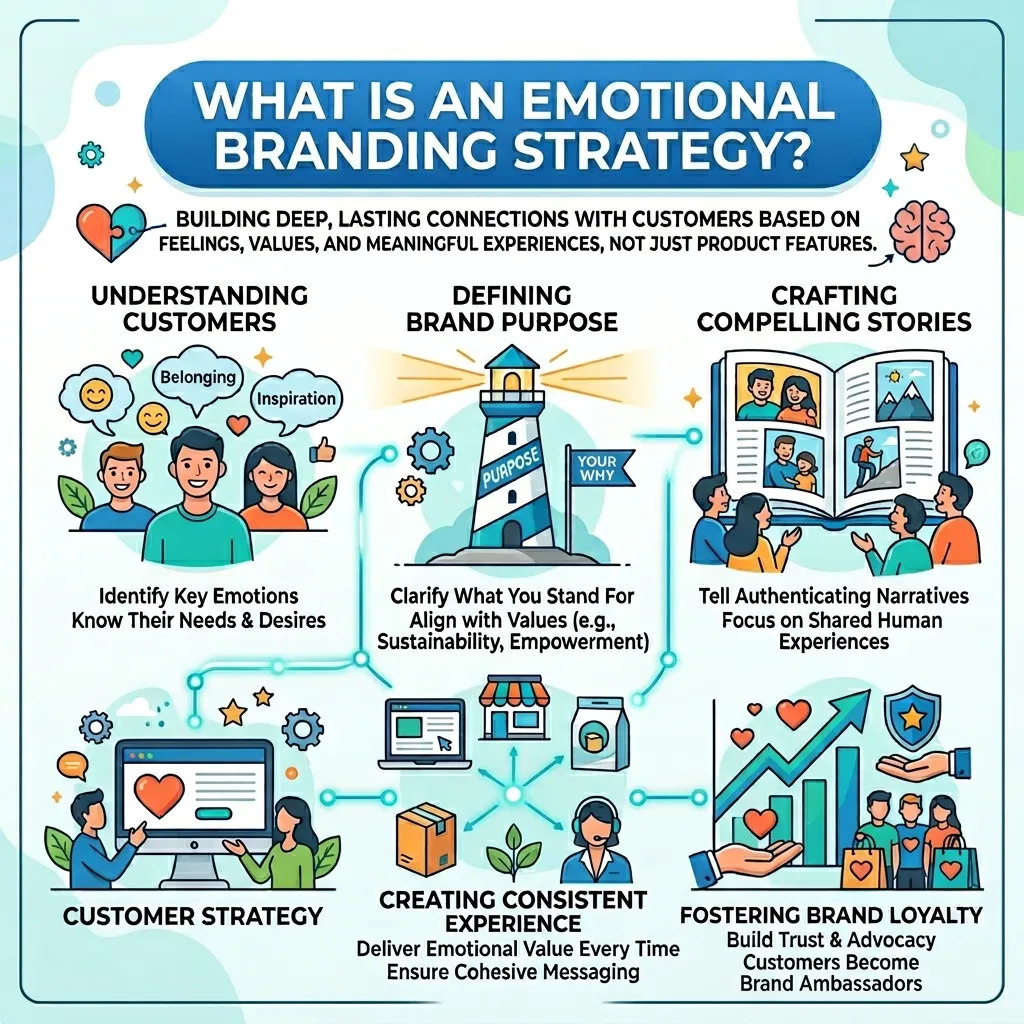
An Emotional Branding Strategy is the deliberate practice of building a brand around feelings, identity, and human connection rather than features alone. It’s the difference between selling a product and selling a sense of belonging.
Traditional marketing tends to focus on the rational: this phone has more storage, this detergent removes more stains, this software saves you ten minutes. An Emotional Branding Strategy works on a deeper level. It asks how you want customers to feel when they think of your brand—and then designs everything around delivering that feeling.
Apple doesn’t sell processors; it sells creativity and status. Nike doesn’t sell rubber soles; it sells determination. These companies built an Emotional Branding Strategy so strong that their customers feel personally connected to what the brand stands for.
How Emotions Influence Purchasing Decisions
Emotions act as mental shortcuts. When we face too many options, feelings help us decide faster. Neuroscientist Antonio Damasio found that people with damage to the emotional centers of their brains struggle to make even simple decisions, despite having normal reasoning ability. In other words, emotion isn’t the enemy of good decisions—it’s a requirement for making them.
For brands, this means that the feelings you spark can matter more than the facts you list. A customer who feels understood, inspired, or comforted by your brand is far more likely to choose you and stick with you.
Why Storytelling Drives Emotional Connection
Stories are how humans have shared meaning for thousands of years. A good brand story gives people something to relate to—a struggle, a hope, a transformation. When a customer sees their own life reflected in your narrative, they form an emotional bond that pure data could never create.
This is why storytelling sits at the center of any strong Emotional Branding Strategy. A story about why your founder started the company, or how your product changed someone’s day, will outlast any feature list.
What Are the Benefits of a Strong Emotional Brand?
Building real emotional connection takes effort, but the payoff is significant and long-lasting.
- Increased loyalty and advocacy. Emotionally connected customers are more valuable over their lifetime and more likely to recommend you. A study published in the Harvard Business Review found that emotionally connected customers are more than twice as valuable as highly satisfied customers.
- Stronger brand perception and value. When people feel something positive about your brand, they perceive higher quality and are often willing to pay more.
- Competitive differentiation. Competitors can copy your features and undercut your prices. They can’t copy how your brand makes people feel.
How to Craft Your Emotional Branding Strategy

Building an Emotional Branding Strategy isn’t guesswork. It follows a clear sequence of steps, each building on the one before.
Step 1: Identify Your Brand’s Core Emotions and Values
Start by asking a simple question: how do you want people to feel after interacting with your brand? Comforted? Empowered? Excited? Reassured?
Pick two or three core emotions and tie them directly to your brand’s mission and values. A children’s hospital might center on hope and trust. An adventure-gear company might focus on freedom and courage. These core emotions become the foundation of your entire Emotional Branding Strategy, so choose ones that genuinely reflect what your company stands for.
Step 2: Map Your Audience’s Emotional Buying Journey
You can’t connect with people you don’t understand. Use market research, interviews, and customer feedback to learn what your audience truly cares about—their fears, frustrations, and dreams.
Then map the Emotional Buying Journey: the sequence of feelings a customer moves through from first awareness to long-term loyalty. At the start, they might feel uncertain or overwhelmed. Mid-journey, they may feel hopeful as they discover you. After buying, they should feel reassured and proud. Understanding each emotional stage of the Emotional Buying Journey helps you deliver the right message at the right moment, easing pain points and amplifying aspirations along the way.
Step 3: Develop Your Brand Story
With your core emotions and audience insights in hand, build your brand story. A compelling narrative usually includes a relatable hero (often the customer), a challenge they face, and the transformation your brand helps create.
Two things matter most here: authenticity and consistency. Audiences can spot a fake story instantly, and inconsistency erodes trust. Your story should be true to your origins and repeated consistently across every channel.
Step 4: Build an Emotional Brand Experience Into Your Identity
Your strategy only works if customers feel it at every touchpoint. This is where you turn emotion into a tangible Emotional Brand Experience.
- Visual branding. Marketing visual design drives much of the emotional response people have to a brand. Colors carry meaning—blue often signals trust, red signals energy and passion, green suggests calm and nature. Typography and imagery should reinforce the same feelings. Thoughtful marketing visual design drives recognition and emotional recall long before a customer reads a single word.
- Tone of voice. The way you write and speak should match your core emotions. A playful brand and a luxury brand sound nothing alike, and that’s the point.
- Product and service design. Even the unboxing moment or the ease of a checkout flow shapes the Emotional Brand Experience. Every detail either strengthens or weakens the feeling you’re trying to create.
How Do You Implement an Emotional Branding Strategy?
A strategy on paper means little until it shows up in your daily marketing. Here’s where emotion meets execution.
Content Marketing for Emotional Connection
Blog posts, videos, and social media are powerful tools for sparking emotion. Share customer stories, behind-the-scenes moments, and content that speaks to your audience’s hopes and challenges. User-generated content and testimonials work especially well because they show real people feeling real things about your brand—a trust signal no ad can match.
Personalized Email Marketing Strategy
An emotionally intelligent Email Marketing Strategy treats subscribers as individuals, not list entries. Segment your audience and tailor messages to where they are in their journey. A welcome email should feel warm and reassuring. A re-engagement email might tap into nostalgia or curiosity. The best Email Marketing Strategy uses personalization—names, past behavior, relevant offers—to make every message feel like it was written for one person.
Emotional Customer Engagement in Service and Support
Customer service is one of the most overlooked drivers of emotional branding. A single empathetic interaction can turn a frustrated customer into a lifelong advocate. Strong Emotional Customer Engagement means training your team to listen, show genuine understanding, and solve problems with care. Trust and rapport are built in these moments, often more than in any campaign. Consistent Emotional Customer Engagement reassures customers that the feelings your marketing promised are real.
How Do You Measure the Impact of Emotional Branding?

Emotion can feel hard to quantify, but the right metrics make it visible.
Key Performance Indicators to Track
- Brand sentiment and perception. Are people speaking about your brand positively, negatively, or neutrally?
- Customer retention and lifetime value. Emotionally connected customers tend to stay longer and spend more, so rising retention is a strong signal.
- Social media engagement. Likes, shares, comments, and saves show how deeply your content resonates.
Tools and Techniques for Measurement
Surveys and direct feedback reveal how customers feel in their own words. Net Promoter Score (NPS) is a quick way to gauge advocacy. Social listening and sentiment analysis tools scan online conversations to track the emotional tone surrounding your brand over time. Together, these methods turn fuzzy feelings into actionable data.
Challenges and Considerations
An Emotional Branding Strategy comes with real risks worth managing.
- Avoid manipulation. There’s a line between connecting with emotions and exploiting them. Cross it, and you’ll damage trust permanently. Aim to serve your audience, not trick them.
- Stay consistent. A warm email followed by a cold support call sends mixed signals. Consistency across every touchpoint is what makes emotional branding believable.
- Adapt over time. Emotional landscapes shift with culture, current events, and customer expectations. What felt right last year may feel tone-deaf today, so keep listening and adjusting.
Final Thoughts on Building Lasting Connections
An Emotional Branding Strategy isn’t a clever campaign you run once—it’s a long-term commitment to making people feel something genuine every time they encounter your brand. When you identify your core emotions, understand the Emotional Buying Journey, tell an authentic story, and deliver a consistent Emotional Brand Experience, you build relationships that price wars and feature races can’t touch.
Start small. Pick one or two core emotions, audit how your brand currently makes people feel, and choose a single touchpoint to improve this week. Emotional connection compounds over time, and the brands that invest in it now will be the ones customers stay loyal to for years.
Frequently Asked Questions
What is the difference between emotional marketing and emotional branding?
Emotional marketing refers to individual campaigns designed to spark a feeling and drive a short-term action, like a heartfelt holiday ad. Emotional branding is the long-term strategy of building your entire brand identity around consistent emotional connection. Marketing is a tactic; branding is the foundation.
How do I identify the core emotions for my brand?
Look at your brand’s mission, your customers’ deepest needs, and the feeling you want people to walk away with. Interview loyal customers about why they chose you and how you make them feel. The themes that repeat are your core emotions.
Can emotional branding work for B2B companies?
Yes. B2B buyers are still human, and decisions often hinge on emotions like trust, fear of risk, and the desire for professional recognition. An Emotional Branding Strategy that reduces a buyer’s anxiety or makes them feel like a smart, capable decision-maker can be highly effective.
How long does it take to see results from an emotional branding strategy?
Short-term metrics like engagement can shift within weeks, but deeper results—loyalty, advocacy, and lifetime value—typically take six months to a year or more. Emotional branding is a long game that rewards patience and consistency.
Is emotional branding always positive?
Not necessarily. Some brands use emotions like fear or urgency, which can work but carry risk. Negative emotions can drive action in the short term while damaging trust over time, so they should be used carefully and ethically.
How do visual elements contribute to emotional branding?
Marketing visual design drives a large share of first impressions. Colors, typography, and imagery trigger emotional associations almost instantly—often before a customer reads any words—making visual consistency essential to the Emotional Brand Experience.
What role does storytelling play in emotional branding?
Storytelling is central. A relatable narrative lets customers see themselves in your brand, creating a bond that facts alone can’t build. Stories about your origins, your values, or your customers’ transformations make your brand memorable and human.
How can I measure the effectiveness of my emotional branding efforts?
Track brand sentiment, customer retention, lifetime value, Net Promoter Score, and social media engagement. Combine quantitative data with qualitative feedback from surveys and social listening to get a full picture of how customers feel.
What are some common mistakes to avoid in emotional branding?
The biggest mistakes are inauthenticity, inconsistency, and manipulation. Faking emotions, sending mixed signals across channels, or exploiting customer fears will all erode the trust your Emotional Branding Strategy is meant to build.
How does emotional branding impact customer loyalty?
Emotionally connected customers feel a personal stake in your brand, which makes them less price-sensitive, more forgiving of mistakes, and more likely to recommend you. This loyalty translates directly into higher retention and lifetime value.
Can a small business use an emotional branding strategy effectively?
Absolutely. Small businesses often have an advantage because they can build genuine, personal relationships at scale that large corporations struggle to replicate. Authentic Emotional Customer Engagement and a strong founder story go a long way.
How does the emotional buying journey differ from a standard sales funnel?
A standard sales funnel tracks actions—awareness, consideration, purchase. The Emotional Buying Journey tracks feelings at each of those stages, from initial uncertainty to post-purchase pride. Mapping the Emotional Buying Journey helps you address the emotion behind every action, not just the action itself.