Humor in Marketing Psychology: Why Funny Ads Work So Well
Few emotional tools are as powerful — or as underused — as humor, which is exactly why understanding humor in marketing psychology matters for anyone building brand campaigns. This guide breaks down why funny ads work, the psychological mechanisms behind humor’s effect on memory and trust, the different types of humor brands use, and the real risks of getting it wrong. If you’ve ever wondered why a well-timed joke sticks with you longer than a straightforward pitch, humor in marketing psychology explains exactly what’s happening in your brain when you laugh at an ad — and why that laugh so often turns into a sale.
Why Humor Works So Well in Marketing
Humor in marketing psychology isn’t just about entertainment — it taps into specific cognitive and emotional processes that make messages more memorable and brands more likable. When a joke lands, it triggers a small dopamine release, the same neurochemical reward tied to pleasure and motivation. That reaction doesn’t just feel good in the moment; it gets associated with the brand that caused it.
This is the core insight behind humor in marketing psychology: humor doesn’t just make people feel positive, it makes that positive feeling stick to the brand itself. Unlike straightforward informational ads, which compete for logical attention, humorous ads compete for emotional attention — and emotional memories tend to outlast rational ones.
The Psychological Mechanisms Behind Humor in Marketing
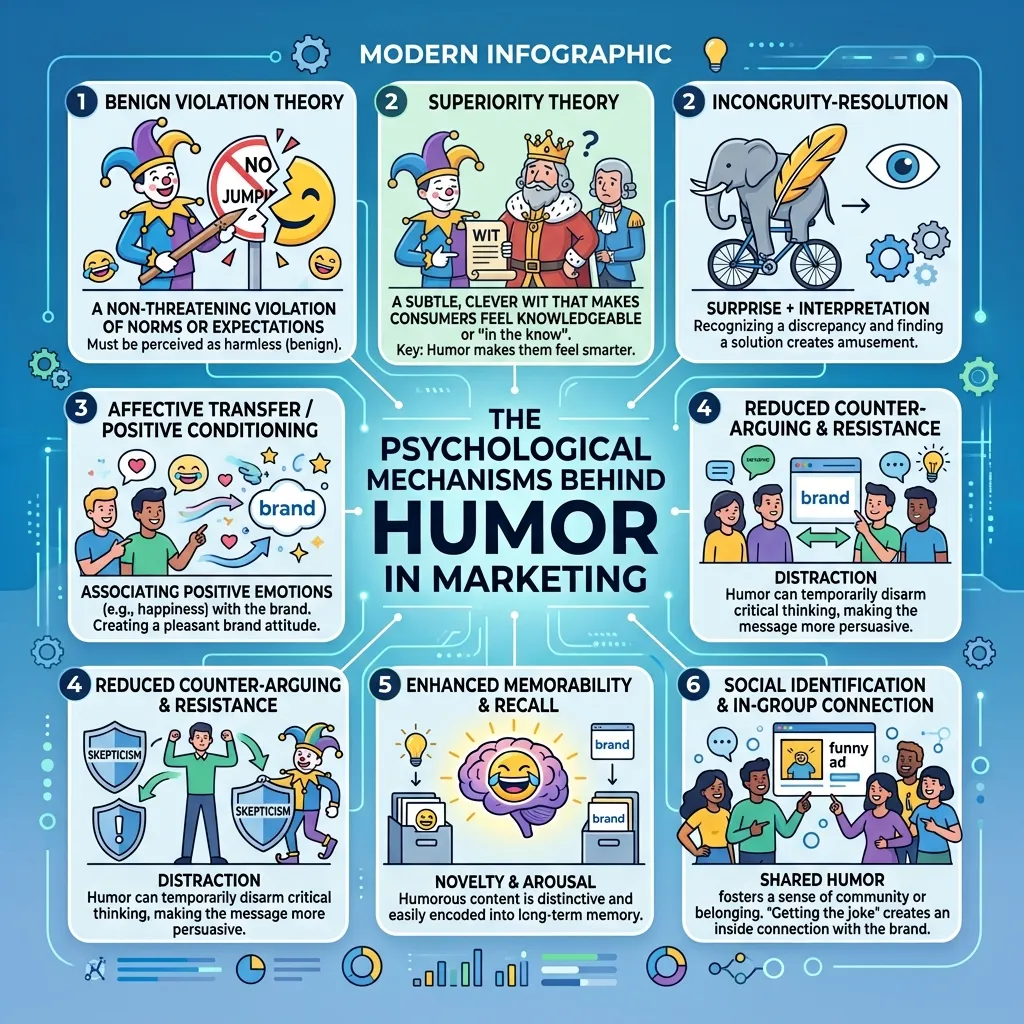
1. The Incongruity-Resolution Effect
Most humor theories agree that laughter comes from incongruity — something unexpected that violates our mental predictions — followed by a resolution that makes sense of the surprise. In advertising, this pattern (setup, twist, punchline) forces active mental engagement, which increases how deeply the message gets processed and remembered.
2. Lowered Psychological Defenses
People are naturally skeptical of advertising, often processing sales messages with a degree of mental resistance. Humor in marketing psychology works partly because laughter lowers that defensive posture. When someone is amused, they’re less likely to critically scrutinize the underlying sales message, which makes humorous ads more persuasive than their serious counterparts, even when the actual claims are similar.
3. The Mere Exposure and Likability Effect
Humor increases likability, and likability is one of the strongest predictors of purchase intent in consumer psychology research. Brands that make people laugh are perceived as more relatable, more human, and less corporate — a major advantage in categories where trust is a differentiator.
4. Enhanced Memory Encoding
Emotionally charged content, including humor, is encoded more strongly in memory than neutral content. This is why people can often recall a funny commercial from years ago but struggle to remember a straightforward one from last week. Humor in marketing psychology directly leverages this memory bias to extend a campaign’s shelf life well beyond its initial airing.
For a broader look at how different emotional states affect consumer decision-making beyond just humor, our guide to the types of emotions used in marketing covers the wider emotional toolkit brands draw from.
Types of Humor Used in Marketing
Not all humor works the same way, and understanding the different categories helps explain why some campaigns succeed while others fall flat.
Self-deprecating humor: Brands poke fun at their own shortcomings or history, which builds trust by signaling honesty and confidence. This works especially well for brands recovering from a public misstep.
Absurdist or surreal humor: Unexpected, illogical scenarios that surprise the viewer. This style tends to generate strong social sharing because of its novelty, even if it doesn’t always tie directly back to product benefits.
Wit and wordplay: Clever copywriting, puns, and double meanings. This style works particularly well in text-based formats like print, email subject lines, and social captions.
Observational humor: Jokes rooted in shared, relatable experiences — the kind of humor that makes people nod and think “that’s so true.” This category tends to perform well because it builds an immediate sense of connection.
Satire and parody: Humor that pokes fun at industry norms, competitors, or cultural trends. This is higher-risk, higher-reward territory, since satire can alienate audiences who don’t share the same reference points or sense of humor.
When Humor in Marketing Works Best
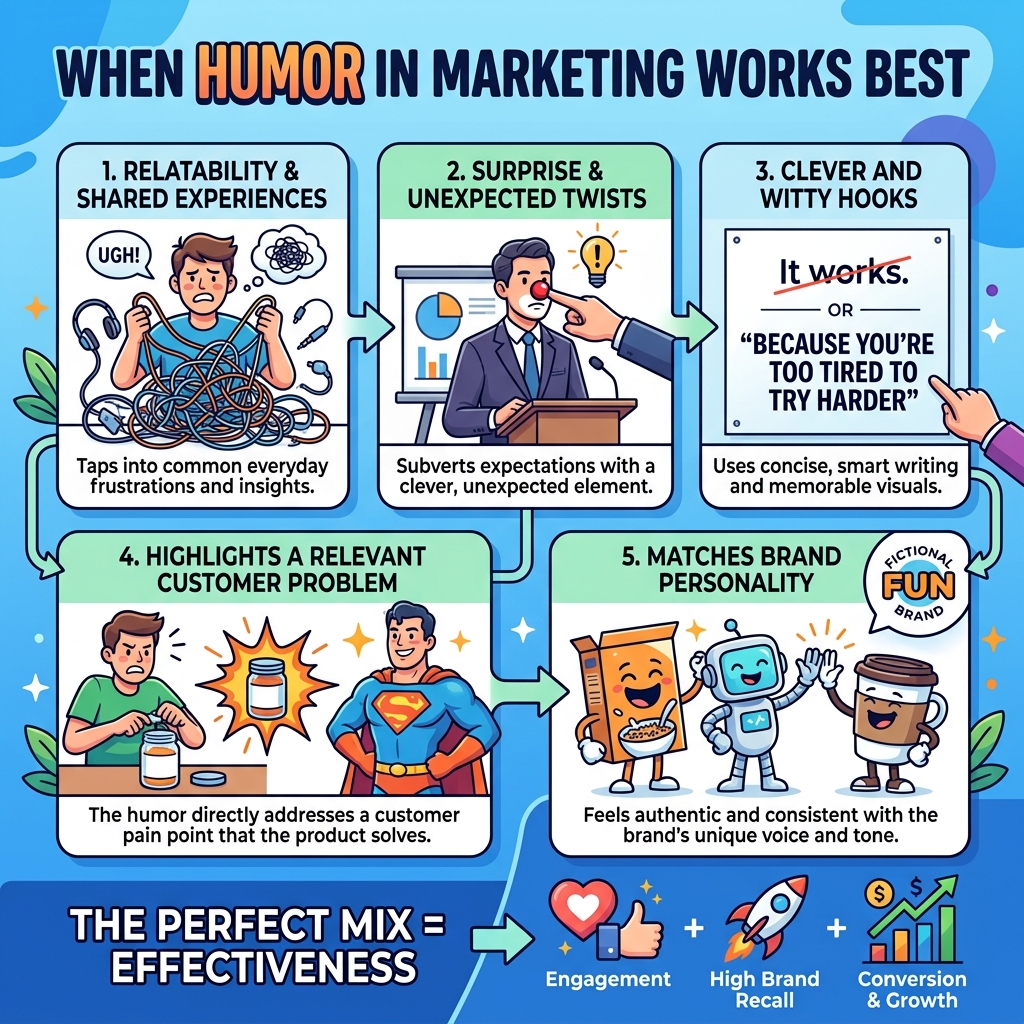
Humor in marketing psychology isn’t universally effective — context matters enormously. A few conditions tend to predict success:
- Low-involvement, low-risk products (snacks, beverages, everyday consumer goods) generally tolerate humor better than high-stakes purchases like insurance, medical services, or financial products, where humor can undercut perceived seriousness.
- Crowded, low-differentiation categories benefit from humor because it’s one of the few ways to stand out when product features are similar across competitors.
- Younger target audiences tend to respond more favorably to irreverent or absurdist humor styles compared to older demographics, who often prefer wit or gentle observational humor.
- Brand awareness campaigns benefit more from humor than direct-response campaigns, since humor is better suited to building memorability than driving an immediate, urgent action.
The Risks of Getting Humor Wrong
Understanding humor in marketing psychology also means understanding its failure modes, since a joke that misses can do real damage to a brand.
Common risks include:
- Cultural misalignment. Humor is one of the most culturally specific forms of communication, and jokes that land in one market can confuse or offend in another.
- Punching down. Humor that targets a vulnerable group, even unintentionally, tends to generate backlash disproportionate to the original joke’s intent.
- Undermining brand credibility. For categories where trust and seriousness matter — healthcare, legal services, financial planning — humor can inadvertently signal that the brand doesn’t take the customer’s problem seriously.
- Aging poorly. Humor tied closely to current trends or memes can feel dated quickly, unlike more timeless emotional appeals.
- Overshadowing the message. If the joke is more memorable than the product or brand name attached to it, the humor has failed at its actual marketing job, regardless of how many laughs it generated.
Cognitive biases play a role here too — audiences often remember the emotional peak of an ad more than its specific claims, which is why understanding cognitive bias in marketing is a useful companion to humor strategy, since biases like the peak-end rule directly shape what viewers actually retain from a funny campaign.
How to Use Humor in Marketing Effectively
1. Know your audience’s specific sense of humor. What lands with one demographic or region can fall completely flat — or backfire — with another.
2. Keep the brand and product central to the joke. The most effective humorous ads integrate the punchline with the product benefit, rather than treating humor as a separate hook bolted onto an unrelated message.
3. Test before you launch widely. Humor is subjective, and a small focus group or limited rollout can catch cultural blind spots before a campaign reaches a mass audience.
4. Match humor style to brand voice. A financial services brand attempting absurdist humor risks feeling inauthentic, while the same style might work naturally for a snack food or entertainment brand.
5. Balance humor with clarity. Even the funniest ad still needs to clearly communicate what’s being sold and why it matters — humor should amplify the message, not replace it.
For a wider framework on how advertising psychology shapes consumer response beyond humor specifically, our psychology of advertising guide covers the broader principles that humor-based campaigns still need to follow.
Humor vs. Other Emotional Marketing Strategies
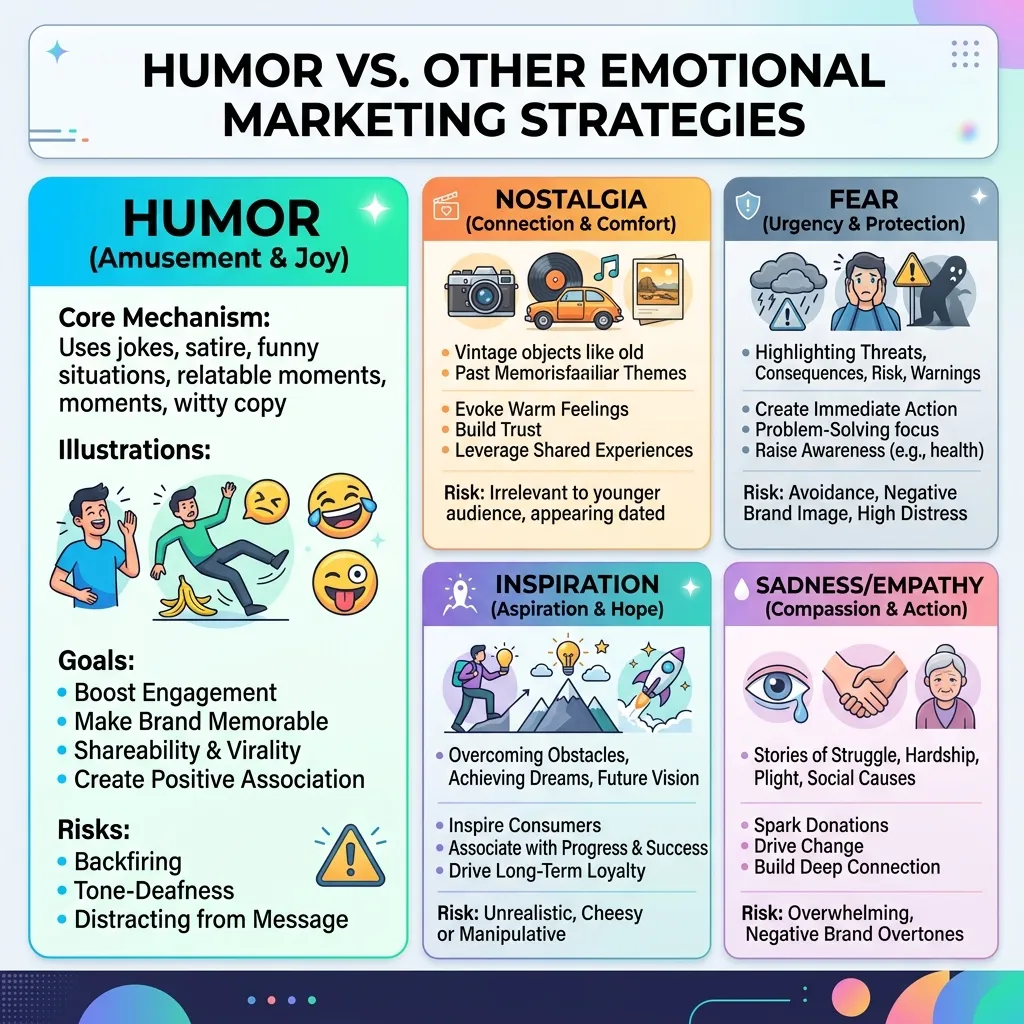
Humor is just one tool in the emotional marketing toolkit, and it’s worth understanding how it compares to other commonly used emotional appeals.
Humor vs. fear appeals: Fear-based marketing (common in insurance, security, and health categories) drives urgency but can create negative brand associations if overused. Humor tends to build more positive, lasting brand affinity, though it’s less effective at driving immediate action.
Humor vs. nostalgia: Nostalgia marketing taps into warm memories and identity, while humor taps into present-moment surprise and delight. The two can be combined effectively, as seen in campaigns that use comedic callbacks to earlier eras or cultural moments.
Humor vs. sadness or empathy appeals: Sad or emotionally heavy campaigns tend to generate stronger short-term emotional intensity and can be highly effective for cause marketing, but they’re harder to repeat frequently without audience fatigue. Humor, by contrast, tends to wear better across a long-running campaign.
Research from the American Psychological Association on the role of humor supports the idea that humor serves as a genuine social and emotional bonding mechanism, not just entertainment — which helps explain why it translates so effectively into brand affinity when used well.
Conclusion
Humor in marketing psychology works because it operates on mechanisms far deeper than simple entertainment — it lowers defenses, strengthens memory, and builds the kind of likability that straightforward messaging struggles to achieve. But humor is also one of the riskier emotional tools available to marketers, since a joke that misses can damage credibility just as effectively as a joke that lands can build it. The brands that use humor most successfully treat it as a precision tool, not a blanket strategy — matching the right type of humor to the right audience, category, and moment, while keeping the actual product message clearly in view. Done well, humor doesn’t just make people laugh; it makes them remember, trust, and eventually choose your brand over the alternative.
Frequently Asked Questions
1. Why does humor work so well in marketing?
Humor in Marketing Psychology explains how humor creates positive emotions and makes advertisements more enjoyable and memorable. These emotional responses can strengthen brand associations and make audiences more receptive to marketing messages.
2. Is humor effective for all types of products?
No. Humor in Marketing Psychology works particularly well for everyday and low-risk products. However, industries such as healthcare, legal services, and financial services may need a more serious tone to maintain trust and credibility.
3. What’s the most effective type of humor for advertising?
There is no single best type. Humor in Marketing Psychology suggests that observational humor, clever wordplay, and relatable situations can be effective because they are easy for audiences to understand. More extreme humor may create attention but also carries greater risk.
4. Can humor in marketing backfire?
Yes. Humor in Marketing Psychology also highlights the risks of humor, including offensive jokes, cultural misunderstandings, poor timing, or humor that distracts from the product. Testing campaigns before a major launch can help reduce these risks.
5. Does humor help with brand recall?
Yes. One important principle of Humor in Marketing Psychology is that emotionally engaging content can be easier to remember than purely informational advertising. When audiences enjoy an ad, they may also remember the brand and message more easily.
6. Is humor better for brand awareness or direct response campaigns?
Humor in Marketing Psychology generally supports brand awareness, attention, and brand likability particularly well. Humor can also work in direct-response campaigns when the advertisement clearly communicates the product benefit and encourages a specific action.
7. How do I know if my audience will respond well to humor?
Understanding your audience is essential to applying Humor in Marketing Psychology effectively. Research their cultural background, preferences, age group, and communication style. Small-scale testing can also show whether the humor feels relevant and appropriate.
8. Why do some funny ads fail to drive sales?
According to Humor in Marketing Psychology, humor can become a problem when audiences remember the joke but forget the product. The humor should support the main advertising message rather than completely overshadowing the brand or product benefit.
9. Is self-deprecating humor a good strategy for damaged brand reputations?
It can be useful when handled carefully. Humor in Marketing Psychology shows that self-deprecating humor can sometimes make brands appear more honest and confident. However, it should never be used to dismiss serious customer concerns or avoid responsibility.
10. How does humor compare to fear-based marketing?
Humor in Marketing Psychology focuses on creating positive emotional associations, while fear-based marketing usually creates urgency through concern or perceived risk. Humor may be better for building likability, whereas fear can be more appropriate when immediate action is important.
11. Can humor and other emotional appeals be combined?
Yes. Humor in Marketing Psychology can be combined with nostalgia, surprise, excitement, or other emotional appeals. These combinations can make campaigns more engaging and memorable while strengthening the emotional connection between customers and brands.
12. What’s the biggest risk of using humor in global marketing campaigns?
Cultural differences are a major concern in Humor in Marketing Psychology. A joke that works in one market may be confusing or offensive in another. Global brands should therefore adapt and test humorous campaigns for each target market.